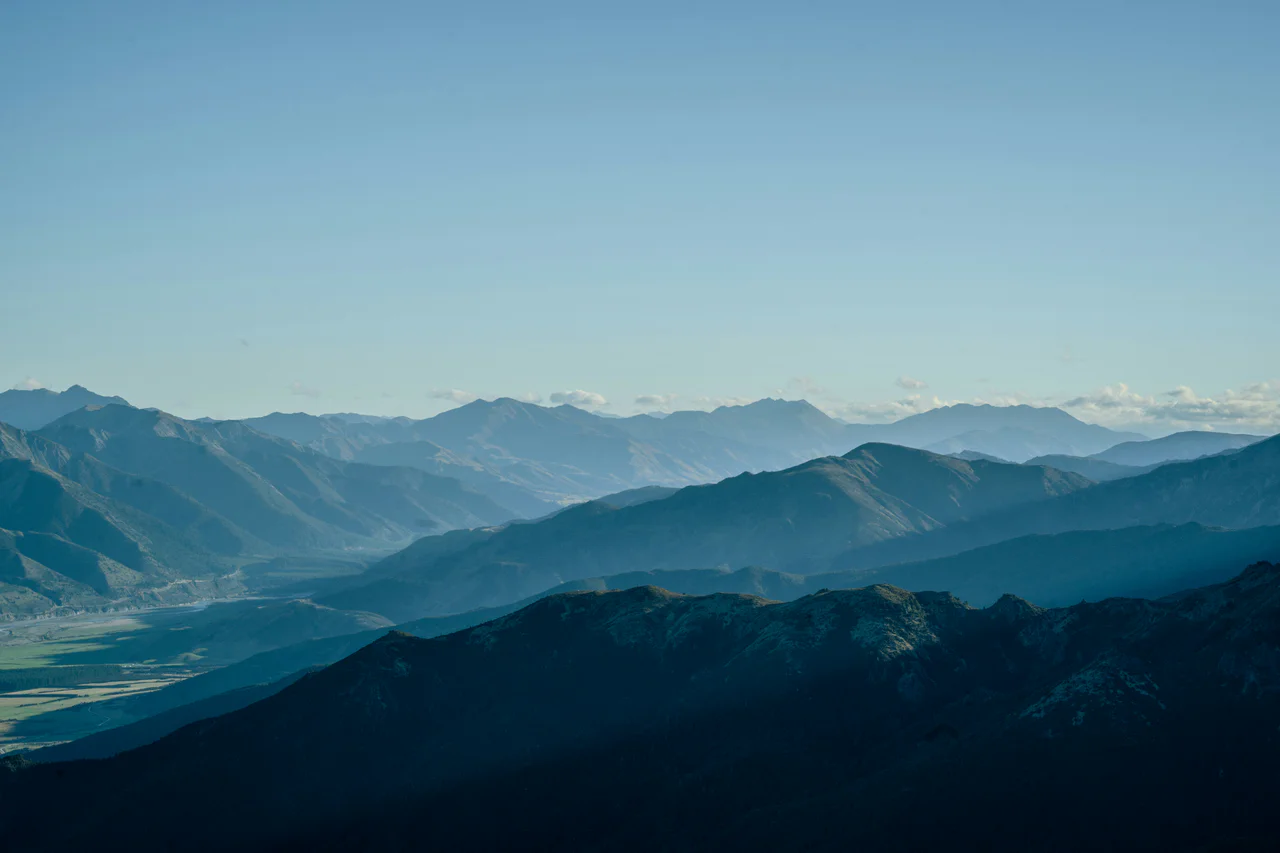
The nearest ridge is green. The next is a hazy grey-blue. The one behind it is almost the colour of the sky.
Sunlit air alone can turn distant ridges blue
Air molecules scatter blue sunlight more than red, and with enough air between you and a ridge, that scattered light forms a blue veil over it. A physics professor at the University of Sydney in Australia wrote in 1955, in words quoted by the Blue Mountains City Library, that any distant object will show some shade of blue for this reason. Atmospheric Optics in the United Kingdom calls the veil airlight and says it occurs anywhere, which includes places with no forest at all.
Carolin Crawford, then Gresham College’s professor of astronomy in the United Kingdom, explains the colour bias in a 2012 lecture. The chance that a photon of sunlight is scattered is inversely proportional to the fourth power of its wavelength. The table works that out for three wavelengths, relative to red light at 600 nm:
| Wavelength | Colour | Relative scattering: (600 ÷ wavelength) multiplied by itself four times |
|---|---|---|
| 450 nm | blue | 3.16 |
| 550 nm | green | 1.42 |
| 600 nm | red | 1 |
Crawford rounds the blue and red comparison to three times. She adds that as the number of scatterings grows over a longer stretch of air, successive ridges look progressively whiter and bluer, and very remote ones can seem to vanish as the air between becomes opaque. That matches your three ridges: the green one shows its own light, the middle one wears a veil of blue, and the far one is nearly all veil.
How oil got into the story
Air is not the whole of the folk story, and trees have long been blamed. In 1900, Lady Audrey Tennyson, the wife of South Australia’s governor, wrote home about the brilliant blue of the hills near Sydney. Her driver told her the gum tree explanation had once been popular but was discredited, and he thought the cause lay in the atmosphere.
In 1955, the Town Clerk of the City of Blue Mountains asked the University of Sydney’s physics department for an answer. After naming Rayleigh scattering as certain, Professor Harry Messel added that light scatters best off very small oil droplets and suggested that fine droplets from oil-bearing trees such as eucalypts were the most plausible reason for the intense blue. He then called it “merely a guess” that, to his knowledge, had not been investigated. The library’s account, taken from a 1994 book, says no complete answer could be given.
From dripping oil to invisible gas
The idea that trees matter did not die, but it changed form. A 2009 study in the Proceedings of the National Academy of Sciences, led by Renyi Zhang at Texas A&M University in the United States, notes that Frits Went first recognised blue haze over forests in 1960 and attributed it to plant emissions. Forests release large amounts of monoterpenes, and the study says α- and β-pinene make up about 60 percent of the terpene budget in the lower atmosphere. These gases react with oxidants, and some products turn into particles.
Atmospheric Optics describes the same chain: the terpenes are invisible gases, and in sunlight they react with ozone and sulphur acids to make nano-sized particles that scatter light into blue haze. Particles smaller than the wavelength of light give a bluish haze, and larger ones give a whiter one.
The lab twist: pollution may help build forest haze
Zhang’s team tested the chemistry in a chamber at about 11°C, using cis-pinonic acid, a product of α-pinene reacting with ozone, along with sulphuric acid and water. Without sulphuric acid, no new particles formed, even when the pinonic acid vapour was 20 to 30 times its saturation concentration. Two or three organic acids together also formed none. With sulphuric acid, particles formed, and the critical nucleus was estimated to hold one pinonic acid molecule and three to five sulphuric acid molecules. In the collected particles, sulphuric acid outweighed pinonic acid by about 1,000 to 1 by mass, and the first growth to 2 or 3 nm came mainly from sulphuric acid and water.
Sulphur dioxide emissions rose over the past century with coal burning, and the authors suggest that human sulphur emissions, mainly from power plants, strongly influence how forest particles form. They also describe the processes as highly complex and not fully understood. So the forest part of the blue may lean on the air that people pollute.
What to look for
Scattering is only one way the sky makes colour. Crawford’s lecture covers ice crystals that bend light into halos, such as a 22 degree moon halo from ice crystals, and diffraction, which a regular structure such as the tracks on a CD also uses to make colour.
Next time you look across layered ridges, take ridges that turn steadily bluer and then fade to sky colour as airlight, sunlit air doing the work, and read a whiter, thicker haze as larger particles joining in.
Still wondering
Sources
Zhang, R. et al.. Formation of nanoparticles of blue haze enhanced by anthropogenic pollution (opens in a new tab), pmc.ncbi.nlm.nih.gov, .
Supports Went's 1960 recognition of forest blue haze, the pinene share of terpenes, the chamber results on sulphuric acid, the particle sizes and the suggested role of human sulphur emissions.
Atmospheric Optics (United Kingdom). OPOD: Blue Forests (opens in a new tab), atoptics.co.uk.
Supports airlight occurring anywhere, terpenes forming nano-sized scattering particles in sunlight, blue haze from small particles and whiter haze from larger ones.
Low, J.. Why are the Blue Mountains blue? (opens in a new tab), library.bmcc.nsw.gov.au, .
Supports the 1900 letter, the 1955 University of Sydney reply on Rayleigh scattering, the oil droplet suggestion and its description as a guess.
Crawford, C.. Atmospheric Phenomena (opens in a new tab), gresham.ac.uk, .
Supports the fourth power law of Rayleigh scattering, ridges looking bluer with distance, larger particles scattering whitely, fog droplet size and the 38 times air path at the horizon.