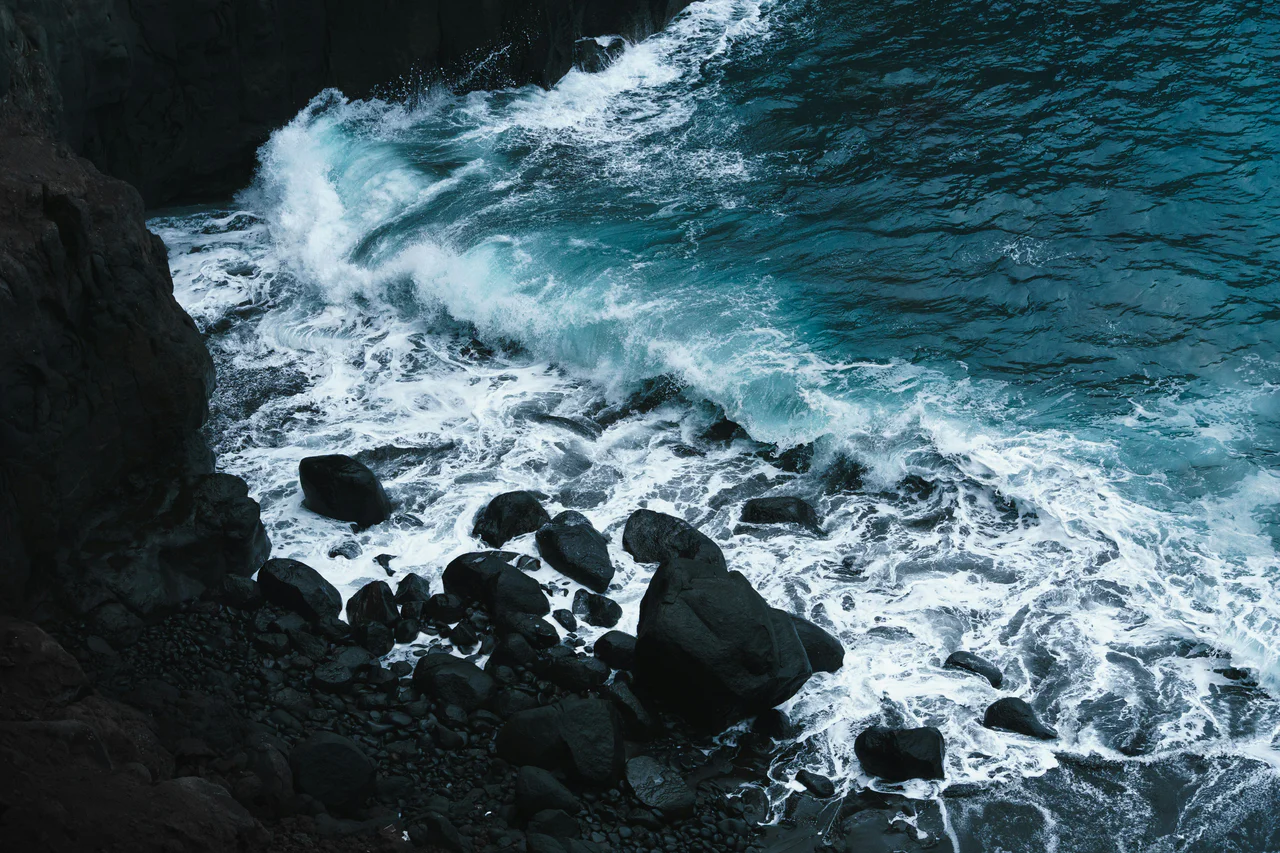
From the first push on its outer membrane to a cell that is ready to flash, a dinoflagellate (a single-celled plankton organism) needs only about 20 milliseconds, according to a 2013 review in the journal Microorganisms. That speed helps explain why a breaking wave on a dark shore can flash electric blue along its edge and fade within a fraction of a second. Why would a cell this small spend energy on that?
The headline holds for seawater with plenty of light-producing dinoflagellates: at night, waves and other water movement stress their cells and trigger blue flashes, though other organisms also glow and not all dinoflagellates do.
A push, a signal, a flash
Dinoflagellates are the most common source of bioluminescence in coastal waters, writes freelance science writer Philip Ball in Physics, the American Physical Society’s online magazine. NOAA, the ocean service of the United States, explains that bioluminescence is light made by chemical reactions in or released from a living organism, and many kinds of marine life, from bacteria to sharks, include some light-making members.
Inside a dinoflagellate, a push on the outer membrane, such as a touch from a grazing animal or the shear of a breaking wave, starts an electrical signal. In the 2013 review by Martha Valiadi and Debora Iglesias-Rodriguez, that signal lets protons, which are charged particles, flow into small light-making compartments, and their pH, a measure of acidity, falls from about 8 to about 6. The change activates an enzyme called luciferase, which oxidises a molecule called luciferin and releases a brief flash of blue light.
A cell does not flash for every push. A laboratory study described in Physics found that indenting a cell wall produced light only when the indenting speed passed a threshold, which suggests the wall absorbs slow pressure without setting off the signal. Maziyar Jalaal at the University of Cambridge, in the United Kingdom, helped run a later study that tested crescent-shaped Pyrocystis lunula cells with fluid jets and direct pressure. He says a response that grows with faster and larger deformations makes adaptive sense, because the light then scales with the severity of a threat. In those tests the light decayed within several tenths of a second.
Flash length varies by species. The 2013 review lists these laboratory figures:
| Dinoflagellate | Flash duration (milliseconds) |
|---|---|
| Noctiluca scintillans | 80 |
| Lingulaulax polyedra (formerly Lingulodinium polyedrum) | 130 to 150 |
| Pyrocystis fusiformis | 500 |
Size matters too. A larger cell has room for more light-making compartments: about 320 in a dark-phase L. polyedra cell, against 100,000 to 200,000 in the larger N. scintillans, according to the review.
Those numbers describe a cell that is ready to flash. Whether it is ready depends on the time of day.
Why the glow is a night event
Most light-making dinoflagellates are much brighter at night, and by day their glow is almost negligible, the review reports. In photosynthetic species, an internal body clock sets this rhythm. In L. polyedra, the light-making enzymes, luciferin and compartments are broken down at dawn and rebuilt from dusk, reaching about 10 times their daytime amounts roughly four hours into the night.
A second control, photoinhibition, means blue light makes cells less sensitive to being pushed. The authors write that it is considered an adaptation that matches the glow to the times when it can be seen and avoids wasting energy, which matters because building the light machinery is thought to be costly. A wave that breaks in daylight pushes the same cells and gets almost nothing back.
What the flash is probably for
The reason a cell would pay for all this is not settled. Scripps Institution of Oceanography in the United States says scientists think the flash works as predator avoidance, startling or confusing animals that might eat the plankton.
The 2013 review fills in the proposals. Early experiments found that copepods, small crustaceans that graze on plankton, ate fewer Gonyaulax cells when the cells were brighter, probably because the flashes disrupted the copepods’ swimming and feeding. A widely accepted idea is the “burglar alarm”: a flash set off by a grazer’s touch draws a bigger predator, which then eats the grazer. Two key experiments agreed with that idea, but the authors point out that neither used organisms that meet in nature, and they say the predator-defence ideas have not yet been tested enough.
The review also estimates that the ability to make light arose independently at least 40 times. A separate hypothesis links its earliest origin to protection from oxygen in a period roughly 2 billion to 500 million years ago. The authors say there is not enough evidence to judge that idea for dinoflagellates, and that a trait’s origin does not imply the same function today. The flash therefore has a well-supported leading explanation that still lacks a decisive test in natural conditions.
When a wave actually lights up
Even where these dinoflagellates live, the display needs the right night. The Department for Environment and Water in South Australia lists a calm, relatively warm sea, plankton gathered near the surface and little moonlight or artificial light. Along that coast the glow usually comes from N. scintillans, and the department stresses that not all dinoflagellates emit light, so plankton in the water does not guarantee sparkle. Other marine life, including fish, squid and tiny crustaceans, can also produce light.
In Southern California, Scripps says the species most often behind glowing red tides is L. polyedra, whose cells measure 35 to 60 micrometres across. When billions or trillions of them are present, they can turn the water reddish brown by day. Not every red tide glows, because that needs light-making species. The 2013 review notes that blue displays from disturbed water have been reported since at least 500 BC, so this is an old observation.
Wait until it is fully dark (Scripps suggests at least two hours after sunset for California’s glowing red tides), let your eyes adjust without a torch or phone light, and watch the surf line, where breaking waves disturb the water.
Short answers
Sources
Valiadi, M. et al.. Understanding Bioluminescence in Dinoflagellates: How Far Have We Come? (opens in a new tab), eprints.soton.ac.uk, .
Supports the 20 millisecond signal pathway, the light chemistry, flash durations, the night rhythm, the burglar alarm idea and the limits of the evidence on the flash's function.
Ball, P.. A Light Squeeze (opens in a new tab), physics.aps.org, .
Supports dinoflagellates as the most common source of coastal bioluminescence, the speed threshold for triggering light and the flash decaying within several tenths of a second.
Scripps Institution of Oceanography (United States). FAQ: Red Tides and Bioluminescence off California (opens in a new tab), scripps.ucsd.edu, .
Supports the cell size of L. polyedra, the link between red tides and glowing waves in Southern California, the predator avoidance view, viewing times and the red tide duration and safety points.
Department for Environment and Water (South Australia). Understanding the natural wonder of bioluminescence (opens in a new tab), environment.sa.gov.au, .
Supports the conditions for sea sparkle, Noctiluca scintillans as the usual South Australian source, the point that not all dinoflagellates glow and the swimming safety advice.
National Ocean Service, NOAA (United States). What is bioluminescence? (opens in a new tab), oceanservice.noaa.gov, .
Supports the definition of bioluminescence as light from chemical reactions in a living organism and its presence across many kinds of marine life.