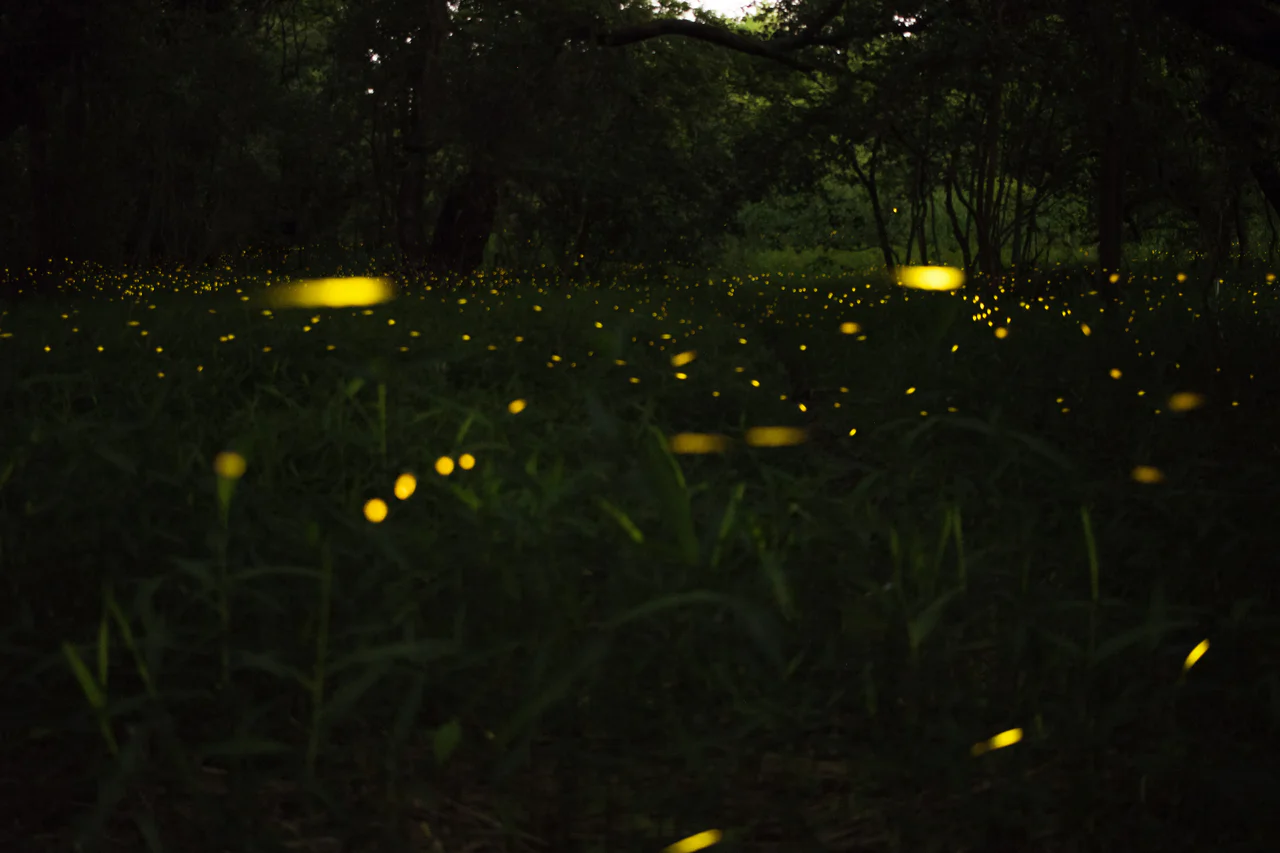
In 1959, two researchers at Johns Hopkins University reported that firefly bioluminescence had a quantum yield of 88%. That number became a textbook fact, repeated for decades in biology and chemistry courses. It was wrong. In 2007, Yonko Ando at the University of Tokyo used a total-photon-flux spectrometer calibrated to measure absolute photon counts and found the actual quantum yield is 41.0%, less than half the older figure. The corrected number is still higher than any other bioluminescent system, but it changes how the reaction should be understood.
The mechanism is a two-step enzymatic reaction. A small molecule called luciferin reacts with adenosine triphosphate (ATP), the same energy currency your cells use, to form an intermediate. That intermediate then reacts with oxygen, producing oxyluciferin in an excited state. When oxyluciferin relaxes, it emits a photon.
Luciferin and luciferase: the fuel and the engine
The reaction begins when luciferin binds to the enzyme firefly luciferase. Luciferase is a large protein, about 62 kilodaltons, and it has a binding site for both luciferin and a magnesium-ATP complex. The enzyme catalyzes the first step: ATP transfers its terminal phosphate group to luciferin, forming luciferyl-adenylate and releasing pyrophosphate. This intermediate is unstable. Oxygen attacks it, forming a four-membered ring called a dioxetanone, and that ring breaks apart to yield oxyluciferin in an electronically excited state. The excited oxyluciferin drops to its ground state and releases a photon in the yellow-green range, peaking at about 565 nanometers. The entire sequence is described in a ScienceDirect overview of firefly biochemistry.
ATP is the spark that starts the reaction
Most bioluminescent organisms do not require ATP. Marine organisms like jellyfish and ctenophores use photoproteins that are prepackaged with oxygen and triggered by calcium. Fireflies are different. They use ATP to activate luciferin before the oxygen step. This is one reason firefly luciferase became a standard tool in molecular biology: if you attach it to a gene promoter, the amount of light produced depends on how much ATP is available, which reflects the metabolic state of the cell. The same reaction that lights up a beetle’s abdomen also lets researchers measure gene expression in a lab dish.
Oxygen and nitric oxide control when the flash happens
The light organ in a firefly’s abdomen is not a single lamp that switches on and off. It is a cluster of photocytes, cells packed with luciferase, surrounded by a network of tracheoles that deliver oxygen. For a flash to occur, oxygen has to reach the photocytes. A 2001 paper by Barry Trimmer and colleagues in Science reported that nitric oxide (NO) regulates this process. The neurotransmitter octopamine triggers NO synthesis in cells between the nerve endings and the photocytes. NO inhibits mitochondrial respiration, which frees oxygen to diffuse into the photocytes and start the reaction. When NO levels drop, oxygen is consumed by the mitochondria again, and the flash ends.
What the light actually costs in photons
A 2026 paper by David Silver in the American Journal of Physics corrected a century-old overestimate of firefly brightness. The original measurement came from William Coblentz in 1912, who reported that a Photinus pyralis flash produced between 1/50 and 1/400 candlepower. Later authors cited the high end of that range and never converted it into photons. Silver’s measurement with a lux meter and a reanalysis of the original data put the actual photon count at roughly 10^10 to 10^11 photons per flash, with a theoretical bound near 10^11. The commonly cited figure of 10^13 photons was off by two orders of magnitude.
The error persisted because early photometry was biased and because modern research reports quantum yields rather than absolute photon counts. When you combine the corrected quantum yield of 41% with the corrected photon count of 10^10 to 10^11, the reaction is still efficient. It is just not as efficient as the textbook says.
Why the flash is cold
Firefly light is often called cold light because it produces very little heat. The reaction converts chemical energy directly into photons, and most of the energy leaves as visible light rather than infrared radiation. A 2008 paper in Nature Photonics reported that the quantum yield is 41%, which means 59% of the energy does not become light. Some of that remainder is lost as heat, but the amount is small. The firefly’s body mass is tiny and its surface area is large, so any heat that is produced dissipates quickly. When you see a firefly glowing on a summer night, you are watching a reaction that wastes less energy as heat than an incandescent bulb, but it is not lossless.
What to watch for next time
The next time you see a firefly flash, you are watching roughly 100 million photons leave a beetle’s abdomen in a fraction of a second. The reaction that produces them starts with ATP, passes through a dioxetanone intermediate, and ends with oxyluciferin dropping to its ground state. The quantum yield is about 41%, not 88%, and the total photon count is about 10^10, not 10^13. Those numbers are lower than the ones in older textbooks, but they are the ones that match what the instruments measure.
Quick questions
Sources
Ando, Y. et al.. Firefly bioluminescence quantum yield and colour change by pH-sensitive green emission (opens in a new tab), Nature Photonics, .
Supports the corrected quantum yield of 41.0%, the discrepancy with the 1959 value of 88%, and the total-photon-flux spectrometer method.
Trimmer, B. A. et al.. Nitric oxide and the control of firefly flashing (opens in a new tab), Science, .
Supports the role of nitric oxide in regulating oxygen access to photocytes and the mechanism of flash control.
Silver, D. H.. How bright is a firefly? Resolving a century of overestimation (opens in a new tab), American Journal of Physics, .
Supports the corrected photon count of 10^10 to 10^11 photons per flash, the critique of the 1912 Coblentz measurement, and the theoretical bound from luciferase abundance.
Fallon, T. R. et al.. Firefly genomes illuminate parallel origins of bioluminescence in beetles (opens in a new tab), eLife, .
Supports the evolutionary origin of luciferase from a duplicated metabolic gene, the independent evolution of bioluminescence in fireflies and click beetles, and the role of luciferin in mate signaling and predator warning.
ScienceDirect. Firefly - an overview (opens in a new tab), sciencedirect.com.
Supports the two-step reaction mechanism, the 565 nm emission peak, the luciferase subunit size, and the ATP requirement.
American Chemical Society. ChemMatters: Fireflies (opens in a new tab), acs.org, .
Supports the role of nitric oxide in flash control and the description of cold light.