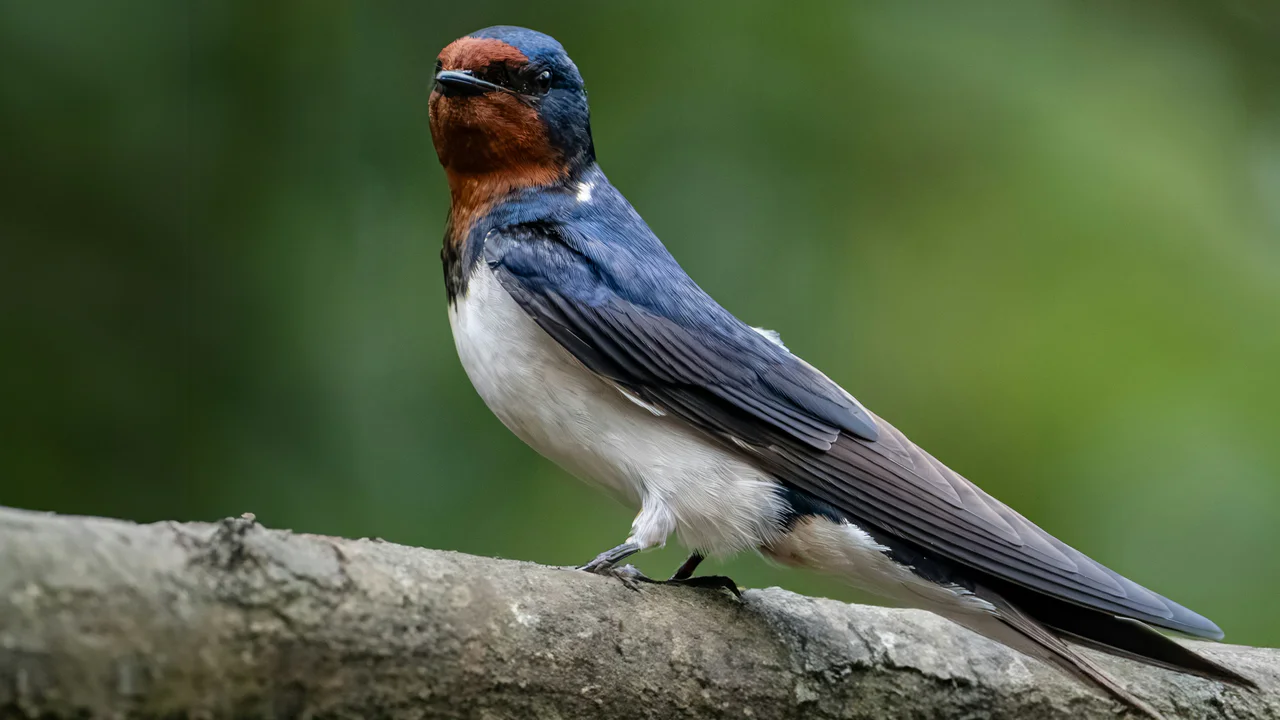
Swallows fly low for reasons linked to weather, but the full explanation remains uncertain
Why do swallows sometimes skim just above the grass when rain seems close? The familiar explanation is that insects descend as the weather changes, and the birds follow their food. That makes biological sense, but research suggests the relationship between weather and swallow flight is more complicated than the old saying implies.
A study published in Frontiers in Ecology and Evolution in 2018 measured the flight altitudes of three aerial insectivores: Purple Martins, Tree Swallows and Barn Swallows. The researchers found differences between species and relationships between flight altitude and atmospheric conditions. They also concluded that more research was needed to establish exactly which conditions drive these patterns.
1. Different swallows fly at different heights
The first clue is that not every swallow uses the same part of the sky.
R. Andrew Dreelin, J. Ryan Shipley and David W. Winkler examined flight behavior using small altitude data loggers attached to birds in upstate New York during the summer of 2016. The loggers recorded information that allowed the researchers to estimate flight altitude over time.
Their 2018 study in Frontiers in Ecology and Evolution compared Purple Martins, Tree Swallows and Barn Swallows.
The results showed that the species differed in how much time they spent at different heights. Purple Martins reached a maximum recorded altitude of 1,945 metres, while Tree Swallows reached 661 metres and Barn Swallows reached 273 metres.
These were the maximum altitudes recorded for the birds in this particular study, not the heights they normally maintained or limits on how high each species can fly.
The researchers also found that the birds’ flight altitudes changed throughout the day. Species differences were especially apparent during the morning and around midday.
That matters because a swallow flying close to the ground is not automatically responding to an approaching storm. Its species, the time of day and the conditions around it can all help explain where it flies.
2. Flying insects respond to the air around them
Swallows catch flying insects while airborne. That makes their feeding behavior closely connected to where insects are available.
The atmosphere is not an empty space through which insects move independently. Air temperature, wind and rising currents influence how insects travel and where they gather.
In their 2018 paper, Dreelin and his colleagues explain that flying insects often occur in clusters. Wind and convection can scatter these clusters or concentrate them in particular places.
Convection refers to the movement of air caused by differences in temperature. On a sunny day, the ground can warm the air above it, causing that air to rise. These upward currents can influence the movement of small flying organisms.
The researchers found that greater thermal uplift was associated with higher flight altitudes in Purple Martins and Tree Swallows. The same relationship was not found in Barn Swallows in their analysis.
This is an important distinction. The air’s movement can affect where birds forage, but the relationship differs between species.
If insects become concentrated near the ground, a swallow feeding on them may also spend more time flying low. If prey is available higher up, the bird may forage there instead.
The food-following explanation is plausible. The remaining question is whether approaching rain reliably creates the particular conditions needed to produce that behavior.
3. Weather changes do not affect every species in the same way
The 2018 study examined several atmospheric variables, including temperature, atmospheric pressure and thermal uplift.
Its results did not reveal one universal response shared by all three species. Some relationships appeared in one species but were not statistically significant in another.
For example, thermal uplift was positively associated with flight altitude in Purple Martins and Tree Swallows, while the researchers found no significant relationship for Barn Swallows. Atmospheric pressure also showed different statistical results across the species.
These findings are more nuanced than the familiar explanation that falling pressure pushes insects downward and swallows simply follow them.
The study supports a relationship between atmospheric conditions and flight behavior. It does not establish that falling air pressure consistently lowers flying insects, that swallows always follow them down, or that the behavior reliably predicts rain.
The distinction matters because several things can happen together before a storm. Temperature, wind, atmospheric pressure, moisture and air movement may change over the same period. Observing a bird’s behavior alone does not tell us which factor caused it.
4. Low-flying swallows are not a dependable rain forecast
Imagine seeing swallows sweep across a field late in the afternoon. Dark clouds are gathering in the distance, and the birds appear to be feeding unusually close to the ground.
It is tempting to connect those observations into a neat sequence: rain is approaching, insects move lower, and swallows follow.
The sequence is possible, but the observation alone cannot establish that it is happening.
Swallows may hunt low because that is where their prey is available. Local insect concentrations, the surrounding landscape and the birds’ normal feeding patterns can all influence where they forage. Weather can affect these conditions without producing the same response every time.
The distinction between a plausible mechanism and a proven forecast is important. A biological explanation can make sense without being sufficiently tested to predict a particular event.
The 2018 study was also limited in scope. It followed breeding birds at selected locations in upstate New York during one summer. The researchers explicitly called for observations across longer periods and a wider range of atmospheric conditions.
Its findings therefore cannot establish a universal rule for every swallow population, climate or approaching storm.
5. The unanswered question is what drives the change
The interesting part of this behavior is the connection between two environments that are easy to think about separately: the air and the animals living in it.
Flying insects respond to atmospheric conditions. Swallows hunt those insects. Changes in the distribution of prey can influence where the birds spend their time, while the birds’ own behavior also varies by species and time of day.
That gives scientists a useful framework for understanding why a swallow might suddenly appear closer to the ground. It also explains why the same visible behavior can have more than one cause.
What remains uncertain is how consistently particular weather conditions produce particular changes in flight altitude, and whether those changes can be used to forecast rain with meaningful reliability.
The researchers’ conclusion was cautious: more data collected across a wider range of conditions is needed to understand these relationships in greater detail.
So the next time swallows skim over a field before a shower, there may be a connection between their feeding and the changing weather. The sight alone, however, cannot tell you exactly which atmospheric change brought them lower or how soon the rain will arrive.
The birds’ behavior is observable. The precise chain of causes, and its usefulness as a weather forecast, still needs further study.
Quick questions
Sources
R. Andrew Dreelin, J. Ryan Shipley and David W. Winkler. Flight Behavior of Individual Aerial Insectivores Revealed by Novel Altitudinal Dataloggers (opens in a new tab), frontiersin.org, .
Supports the species-specific flight altitude findings, the relationships with atmospheric conditions, the study's recorded maximum altitudes and the authors' call for further research.