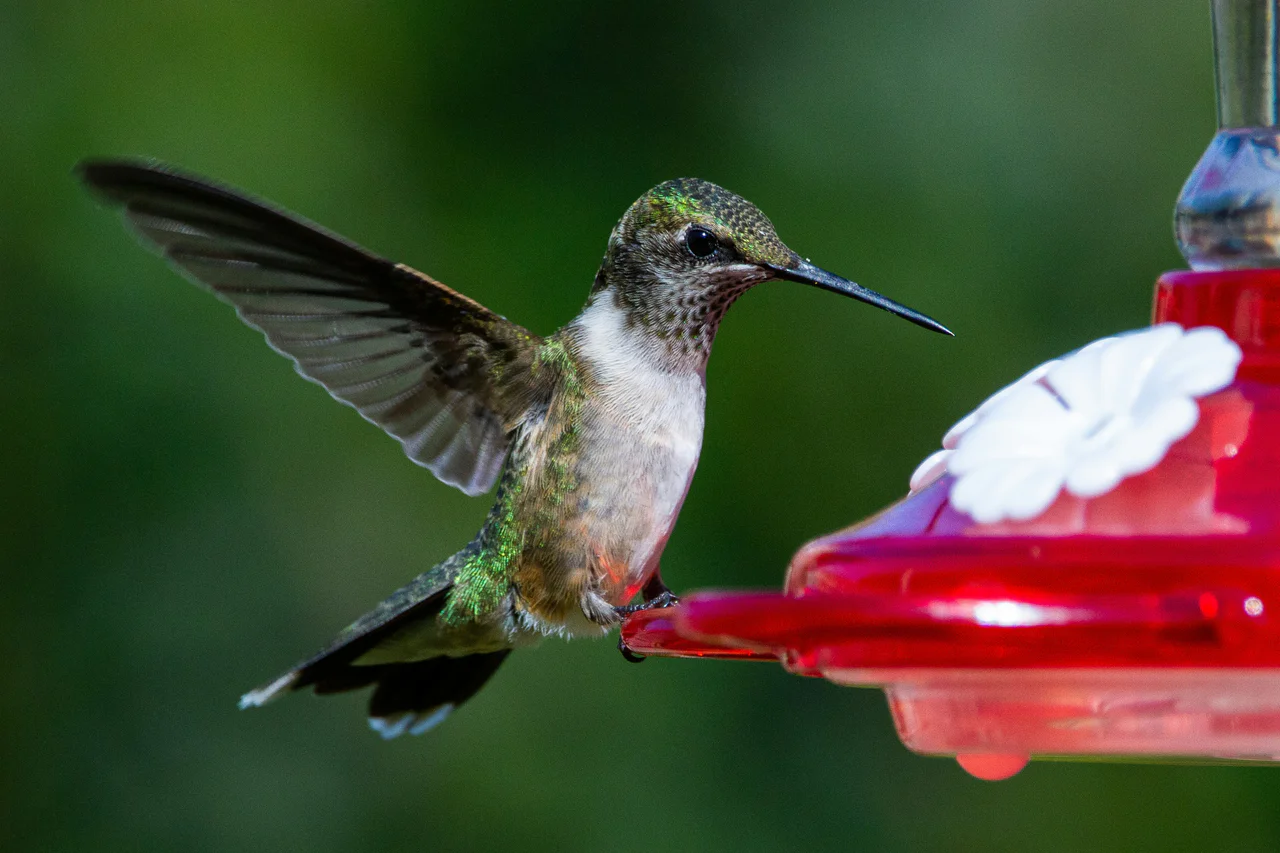
The rufous hummingbird was hovering at a feeder in a wind tunnel, and a sheet of laser light was cutting through the mist of olive oil droplets behind it. When Douglas Warrick and his colleagues at Oregon State University analysed the particle images in 2005, they found something that didn’t match the textbooks. The bird was getting 75% of its weight support from the downstroke and only 25% from the upstroke, according to the paper they published in Nature that June. For decades, the assumption had been that hummingbirds hovered like insects, with equal lift on both strokes. They don’t. They hover like something in between.
The 75/25 split is the reason the wingbeat looks the way it does. If you could slow down a hovering hummingbird enough to trace the path of a single wingtip through one full beat, you wouldn’t see a simple up-and-down arc. You’d see a figure eight, lying almost flat, the wing sweeping forward and then back in a loop that crosses itself at the middle.
The wing sweeps forward, flips, and sweeps back
A hummingbird hovering in front of a flower holds its body nearly vertical. Its wings don’t flap up and down relative to the ground. They sweep forward and backward in a plane that’s close to horizontal, according to the National Park Service’s species profile for the ruby-throated hummingbird. The wing goes forward on the power stroke, generating most of the lift. Then, at the end of that stroke, it rotates about 180 degrees at the shoulder, so the leading edge is pointing the right way for the return stroke. The return stroke sweeps backward, and the wing makes lift again, just less of it.
The figure eight comes from that rotation. The wing isn’t just moving back and forth. It’s also changing its angle of attack, and the tip is rising and falling slightly as the wing twists. If you plot the tip’s position through one full beat, the combination of forward-back motion and twisting produces a closed loop that looks like an eight.
Okay, but why does the wing have to flip?
Because a wing only makes useful lift when its leading edge is pointed into the oncoming air. On the forward stroke, the wing is moving one way, and the leading edge is pointed that way. On the return stroke, the wing is moving the opposite way, and if it didn’t flip, the leading edge would be pointing backward. That would produce drag instead of lift, and the bird would drop.
Insects solve this differently. Their wings are flexible enough to twist and reverse camber mid-stroke, effectively turning inside out. A hummingbird’s wing is made of bone and feathers. It can’t do that. So the bird rotates the whole wing at the shoulder, which is why the wingtip traces a wider loop than an insect’s would. A 2007 study by Bret Tobalske and colleagues in the Journal of Experimental Biology found that rufous hummingbirds have an average wingtip-span ratio of 93%, meaning the wing stays almost completely rigid during the beat. That rigidity is what lets the whole wing rotate as a single unit.
Why doesn’t the upstroke cancel the downstroke?
It would, if the wing were symmetrical. But it isn’t. The wing is cambered, with a curved upper surface and a flatter lower surface. When it flips over for the upstroke, the camber is inverted relative to the airflow, and the wing generates lift in the same direction as before, just less of it. Warrick’s measurements showed that the upstroke contributes about a quarter of the total force needed to hold the bird’s weight. Anna’s hummingbirds hovering in normal air use an average stroke amplitude of 153.6 degrees and a wingbeat frequency of 38.5 Hz, according to high-speed kinematic data reported by Science.gov.
The wing is also doing something else during the upstroke. It’s flexing slightly at the wrist, and the feathers are separating a little, which reduces the drag. The result is a wingbeat that’s mechanically efficient enough to keep a 3-gram bird in the air for hours. Rivers Ingersoll and colleagues found in 2018 that hummingbird flight muscles activate about a quarter of a stroke earlier than those of larger birds, which lets them store elastic energy during stroke reversal. That stored energy helps them get through the turnaround without burning extra metabolic fuel.
Why doesn’t the wing tear itself apart?
Because the muscles and tendons are built for it. Hummingbirds have proportionally enormous pectoral muscles, making up about 25 to 30 percent of their body weight, according to the National Park Service. Those muscles power the downstroke. A smaller muscle, the supracoracoideus, powers the upstroke. Both are activated in a burst pattern that’s consistent from beat to beat, and the timing is tight enough that the wing changes direction without losing aerodynamic force.
The wing also creates a leading-edge vortex on each stroke, a spinning pocket of low pressure that clings to the front of the wing and boosts lift. A robotic hummingbird wing built at New Mexico State University and Los Alamos National Laboratory in 2010 showed that the bird flips the wing on the upstroke so it sheds one vortex and creates another on the other side, maintaining high lift forces throughout the cycle.
Why does it hum?
The hum is the sound of the wingbeat. A ruby-throated hummingbird beats its wings about 50 times per second while hovering, according to the National Park Service. A smaller species beats faster, up to around 80 times per second. Anna’s hummingbirds, a medium-sized species, hover at about 38.5 Hz. Each beat creates a pulse of pressure in the air, and those pulses arrive at your ear at the same frequency as the wingbeat. The pitch of the hum corresponds to the wingbeat frequency and its harmonics. That’s why a hummingbird’s hum sounds like a musical note rather than a buzz.
Why isn’t the figure eight the whole story?
The figure eight tells you how the wing moves through the air, but it doesn’t fully explain how the bird controls its flight. A 2020 study in Current Biology found that when hummingbirds are hit with a sideways gust, they don’t change the overall shape of the figure eight. They change the rotation angle of one wing relative to the other, and they fan their tail. The figure eight stays roughly the same while the bird corrects its roll.
The other open question is how much of the wingbeat is elastic and how much is active. The 2018 Journal of Experimental Biology paper found evidence that hummingbirds store and release energy during stroke reversal, like fruit flies do. But it’s not clear whether the elastic contribution is as large as it is in insects, or whether hummingbirds rely more on muscle. That question is still being worked on.
Short answers
Sources
Warrick, D. R., Tobalske, B. W., and Powers, D. R.. Aerodynamics of the hovering hummingbird (opens in a new tab), Nature, .
Supports the 75% downstroke and 25% upstroke weight support split, the finding that hummingbirds are aerodynamically between insects and other birds, and the DPIV methodology.
Ingersoll, R. et al.. How the hummingbird wingbeat is tuned for efficient hovering (opens in a new tab), Journal of Experimental Biology, .
Supports the elastic energy storage during stroke reversal, the quarter-stroke early muscle activation, and the low induced power losses compared with insects.
Tobalske, B. W. et al.. Three-dimensional kinematics of hummingbird flight (opens in a new tab), Journal of Experimental Biology, .
Supports the 93% wingtip-span ratio and the finding that hummingbird wings are kinematically rigid compared with other birds.
National Park Service. NETN Species Spotlight: Ruby-throated Hummingbird (opens in a new tab), nps.gov, .
Supports the figure-eight wing rotation, the 50-beats-per-second hovering frequency, and the 25 to 30 percent body weight of the pectoral muscles.
Science.gov. Visualization of the vortex wake of a flying animal (opens in a new tab), science.gov.
Supports the 153.6-degree average stroke amplitude and 38.5 Hz wingbeat frequency for Anna's hummingbirds hovering in normal air.
American Institute of Physics. How hummingbirds fight the wind (opens in a new tab), eurekalert.org, .
Supports the leading-edge vortex mechanism, the wing flip on the upstroke, and the robotic hummingbird wing used to study gust response.
Current Biology. Modulation of Flight Muscle Recruitment and Wing Rotation Enables Hummingbirds to Mitigate Aerial Roll Perturbations (opens in a new tab), sciencedirect.com, .
Supports the finding that roll control uses differential wing rotation and tail fanning while the figure-eight trajectory stays largely unchanged.