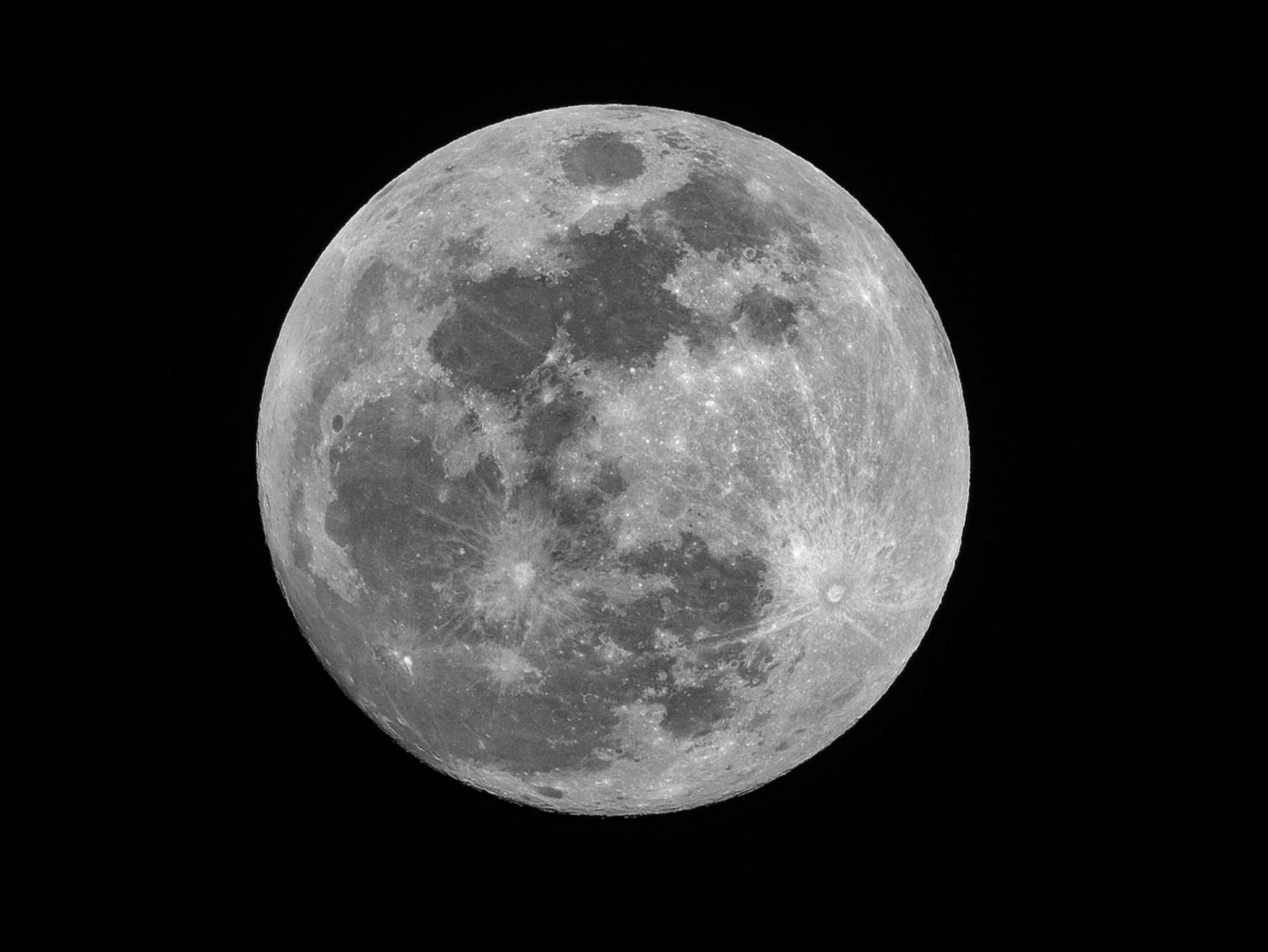
You’re standing outside at night. The moon has a pale ring around it, roughly the width of an outstretched hand held at arm’s length. Someone says it’s going to rain. You wonder whether that old saying holds up.
It partly does. The ring is a real optical phenomenon called a 22-degree halo, and it forms when moonlight passes through millions of tiny ice crystals in high cirrus clouds. Those clouds often arrive ahead of a warm front, and warm fronts bring rain. But the ring is not a guarantee. It is a signal that the atmosphere is changing, not a promise about what happens next.
Why is there a ring around the moon at all?
The ring appears because of ice. High in the atmosphere, between 6 and 12 kilometres up, the air is cold enough that water vapour freezes into tiny hexagonal crystals. These crystals drift in thin, wispy clouds called cirrus. When moonlight passes through them, the light bends. The bending is called refraction, and it happens because light travels at different speeds through air and through ice.
The American Meteorological Society’s Glossary of Meteorology explains that the 22-degree halo is the most common of all halos. It forms when light enters one face of a hexagonal ice crystal and exits through another, getting refracted twice. The effective prism angle is 60 degrees, and the angle of minimum deviation for an ice prism of that angle is about 22 degrees. That is why the ring has a radius of 22 degrees.
Why do the crystals bend light into a circle?
The circle shape comes from the geometry of the crystals and the way they are oriented. Most of the ice crystals in cirrus clouds are hexagonal prisms, long and pencil-shaped. As they fall through the air, they tend to align themselves with their long axes horizontal. When moonlight hits them, the light is refracted at a consistent angle. Because the crystals are randomly oriented around that horizontal axis, the refracted light spreads out in all directions at 22 degrees from the moon. That is what creates the ring.
Not every crystal contributes to the halo you see. The EPFL’s atmospheric optics reference explains that only the crystals at a specific orientation relative to your eye send light into the ring. The crystals are all deviating light similarly, but only the ones in the right position at the right angle contribute to the effect for you as an observer. That is why the halo looks personal, like a rainbow. It is shaped by where you are standing.
Why does the ring mean rain is coming?
Because cirrus clouds come before warm fronts. A warm front is a boundary where a warm air mass slides up over a colder one. As the warm air rises, it cools, and the water vapour in it condenses into clouds. The first clouds to arrive are the high, thin cirrus. They can appear 1,000 kilometres or more ahead of the surface front, according to a warm front description from Skybrary. As the front gets closer, the cirrus thickens into cirrostratus, then altostratus, and finally the nimbostratus that produces steady rain or snow.
The BBC Weather feature on moon halos puts it plainly: ahead of an approaching weather system, you typically get high-level cloud moving in before the cloud gets thicker and thicker. That may eventually bring rain. The halo is a sign that the first stage of that process is happening.
The statistics support the connection. A 1914 study by J. M. Kirk in the Monthly Weather Review analysed 40 years of halo observations at Wauseon, Ohio. Of the 699 lunar halos recorded between 1873 and 1912, 59 percent were followed by precipitation within 24 hours. The numbers improved when the barometer was falling. When the pressure was below normal and falling, 85 percent of halos were followed by precipitation within 24 hours. When the pressure was above normal and rising, only 27 percent were followed by precipitation.
A 1916 follow-up in the Monthly Weather Review found that wind direction mattered too. Of 188 halos recorded, 94 were accompanied or followed by easterly winds and falling pressure. Of those, 82, or 87 percent, were followed by precipitation within 48 hours. The overall rate for all halos in that study was 59 percent.
Why doesn’t it always rain?
Because not every cirrus cloud is followed by a warm front. Sometimes the cirrus is just cirrus. It drifts overhead, produces a halo, and moves on without any precipitation. The EarthSky article on halos notes that the same clouds can occur without any associated weather change, which is why the halo is an unreliable sign of bad weather on its own.
The weather.com explainer quotes senior meteorologist Jonathan Erdman: one thing to look for is whether these thin, wispy cirrus clouds eventually lower and thicken. If they do, then snow or rain is probably on the way. If they stay thin and high, the front may pass without bringing precipitation to your location.
The prediction is not deterministic. It is probabilistic. A halo shifts the odds in favour of rain, but it does not guarantee it. The 1914 study found that even when the barometer was falling, 15 percent of halos were not followed by precipitation within 24 hours. When the barometer was rising, the majority of halos were followed by dry weather.
What to watch for next time
The next time you see a ring around the moon, look at the sky. If the cirrus clouds are thin and wispy and the halo is bright, the front may still be far away. If the clouds start to thicken and lower, and the halo fades, rain is more likely. If you have a barometer, check whether the pressure is falling. A falling barometer with an easterly wind is the strongest signal.
The ring itself is not the predictor. It is the ice crystals in the cirrus clouds that matter, and the front those clouds are riding ahead of. The halo is a visible marker of an invisible process. It tells you that the atmosphere is already in motion, and that something is on the way. Whether that something reaches you is still an open question.
The exact relationship between halo brightness, cloud thickness, and precipitation timing is not fully settled. The 1914 study noted that halos appearing with cirrostratus overflow that precedes an incoming high are almost invariably followed by northerly winds and rarely by precipitation. The same phenomenon can mean different things depending on the larger weather pattern. Meteorologists still use halos as one signal among many, not as a standalone forecast.
Short answers
Sources
American Meteorological Society. Halo of 22° (opens in a new tab), Glossary of Meteorology, .
Supports the definition of the 22-degree halo, the refraction mechanism, the 60-degree effective prism angle, and the darker region inside the halo.
EPFL. 22° halo (opens in a new tab), graphsearch.epfl.ch.
Supports the description of the halo as an atmospheric optical phenomenon, the hexagonal ice crystal refraction, the 22-degree radius, and the wavelength-dependent colouring.
NASA. Moon Corona, Halo, and Arcs over Manitoba (opens in a new tab), APOD, .
Supports the description of the 22-degree halo created by moonlight refracting through six-sided cylindrical ice crystals.
Kirk, J. M.. Halos and Precipitation at Wauseon, Ohio (opens in a new tab), Monthly Weather Review, .
Supports the 59 percent precipitation rate for lunar halos within 24 hours, the 85 percent rate with falling barometer, and the 27 percent rate with rising barometer.
Monthly Weather Review. Halos and Precipitation (opens in a new tab), NOAA, .
Supports the 87 percent precipitation rate for halos with easterly winds and falling pressure within 48 hours, and the 59 percent overall rate.
Childs, Jan Wesner. Here's What A Ring Around The Moon Might Mean For Your Weather (opens in a new tab), Weather.com, .
Supports the description of moon halos forming from ice crystals in cirrus clouds, the 22-degree refraction angle, and the quote from Jonathan Erdman about cloud thickening.
BBC Weather. Ring around the moon? Rain real soon (opens in a new tab), bbc.com, .
Supports the description of halos forming from high-level ice cloud, the 22-degree refraction angle, and the explanation that high-level cloud arrives ahead of an approaching weather system.
Skybrary. Warm Front (opens in a new tab), skybrary.aero, .
Supports the sequence of cloud types associated with an approaching warm front: cirrus first, then cirrostratus, then precipitation.
EarthSky. What makes a halo around the sun or moon? (opens in a new tab), earthsky.org, .
Supports the statement that the same cirrus clouds can occur without any associated weather change, making the halo unreliable as a standalone sign of bad weather.
van Diedenhoven, B. et al.. The prevalence of the 22° halo in cirrus clouds (opens in a new tab), Journal of Quantitative Spectroscopy and Radiative Transfer, .
Supports the finding that the 22-degree halo feature is generally present if pristine crystals contribute more than about 10 percent to the total scattering cross section, and that 37.3 percent of cirrus periods show some indication of the halo.