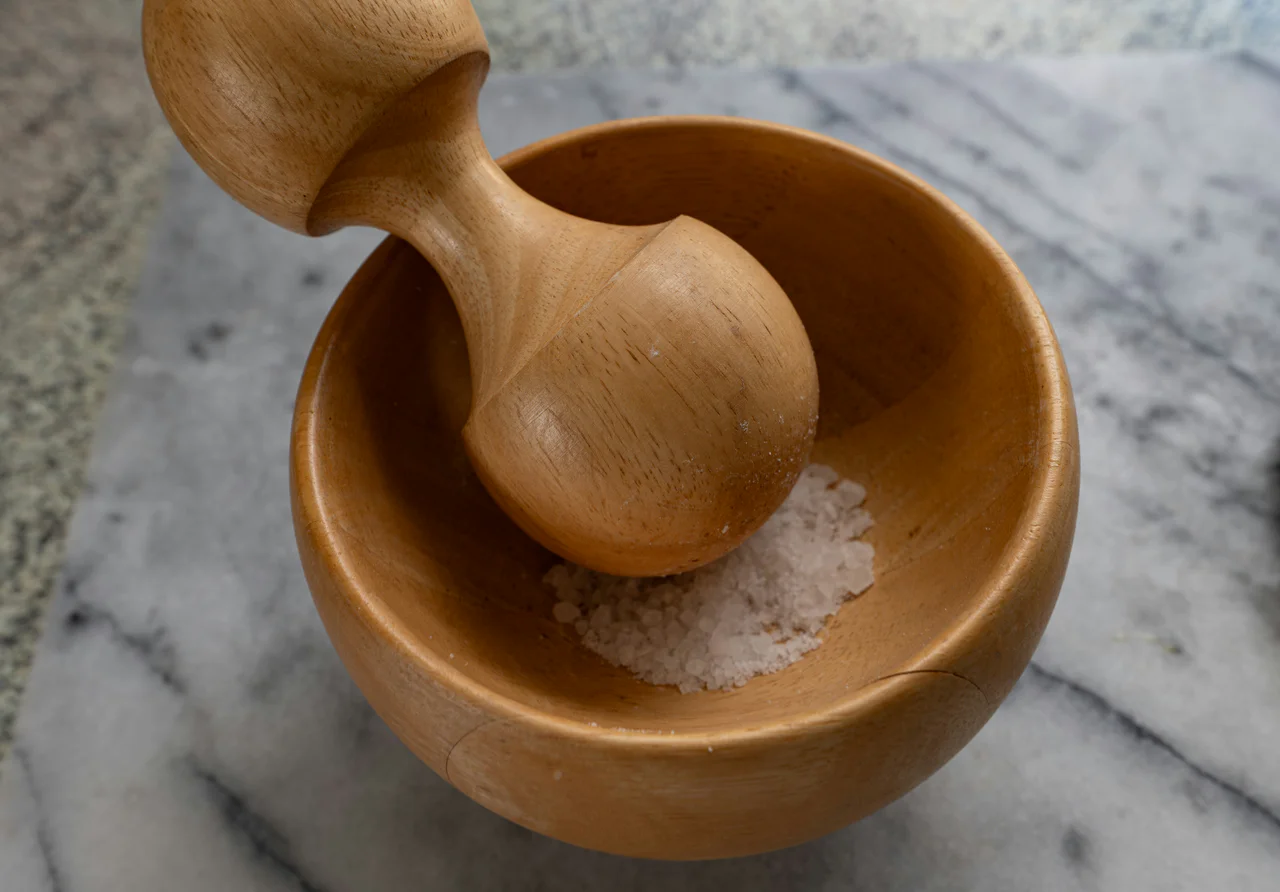
In a 2019 experiment at Korea University in South Korea, sea salt formed the strongest lumps of the dietary salts stored through humidity cycles, and the team linked that to sea salt taking up water at lower humidity than the rest. Tip a shaker over a meal when the air is damp and you may get the same result: stubborn lumps instead of free grains. The claim holds, with conditions: salt takes up water vapour once the air’s relative humidity passes its deliquescence point, about 75 percent for pure sodium chloride at 25°C, and the lumps set when that water dries away. Other minerals in the salt can lower that point.
Food salt is not pure sodium chloride
The Codex Alimentarius standard for food grade salt, part of the joint food standards programme of the UN Food and Agriculture Organization and the World Health Organization, describes salt as a crystalline product that is mostly sodium chloride, taken from the sea, from underground rock salt or from natural brine. It was first adopted in 1985 and revised in 1997. It requires at least 97 percent sodium chloride on a dry basis. The remainder is natural secondary products, which vary with the origin and the production method. They are mainly calcium, potassium, magnesium and sodium sulphates, carbonates and bromides, plus calcium, potassium and magnesium chlorides.
Those last ones matter here, because chlorides do not all take up water at the same humidity.
At what humidity does salt turn damp?
Indiana Public Media’s A Moment of Science explains that salt is hygroscopic, meaning it absorbs water vapour from the air, and that with enough vapour the salt partly dissolves and starts to clump. The tipping point has a name: the deliquescence relative humidity, the relative humidity at which a salt forms a solution. Relative humidity compares the water vapour in the air with the most the air can hold at that temperature.
A 2017 report from Los Alamos National Laboratory in the United States lists reference values drawn from published sources:
| Salt | Deliquescence humidity at 25°C (percent relative humidity) |
|---|---|
| Potassium chloride | 84 |
| Sodium chloride | 75 |
| Magnesium chloride hexahydrate | 33 |
| Calcium chloride hexahydrate | 29 |
Sodium chloride barely moves with temperature in that report: 75 percent at 25°C, 74 percent at 50°C and 76 percent at 70°C. The hydrated magnesium and calcium chlorides dissolve at less than half that humidity, so a salt carrying some of them can start to damp well below 75 percent. The mineral-rich sea salt in the Korean tests behaved that way. A 2020 study by researchers at the Chinese Academy of Sciences and the University of Macau found that the water uptake of sea salt as humidity rises could be predicted from its measured ion content.
Why damp salt becomes a lump
Getting damp is the first step. A 2011 study by researchers at UTC/ESCOM in France describes the usual sequence: water condenses where grains touch, some salt dissolves into a saturated solution, and the salt comes out of solution again as the water evaporates. They also found that the rate at which sodium chloride dissolves is proportional to the gap between the surrounding humidity and the deliquescence humidity, so a very damp day works faster than a slightly damp one.
A 2020 study at the University of Amsterdam in the Netherlands adds that sodium chloride forms strong lumps mainly through cycles of water uptake and evaporation. The team studied liquid bridges between two salt crystals and found that, as water evaporates, a liquid bridge can leave a solid one.
A lump is therefore salt that dissolved where grains met and grew back together as the air dried. Humid air does the dissolving and drier air finishes the weld, which ties caking to swings in humidity.
What stops the weld
Manufacturers add additives to keep salt from liquefying, according to Indiana Public Media, and the Codex standard lists the anti-caking agents it permits. The Amsterdam team tested one possible additive, an iron and meso-tartrate complex called Fe-mTA. It roughens the crystal surfaces, which reduces the contact area between crystals and lets the liquid bridge spread out, so no solid bridge forms as the water evaporates. That result covers one additive in one study.
To judge whether your kitchen puts plain salt at risk, place a hygrometer, a small humidity meter, next to the salt. Readings above about 75 percent near 25°C are where sodium chloride starts taking up water, and mineral-rich salt can start at lower readings.
Back in the Korean experiment, the sea salt that caked most also showed many crystal bridges when the team examined it, the same welds described above. The lumps in your shaker are likely to be built the same way: crystals that dissolved where they touched and grew together.
Short answers
Sources
Doh, H. et al.. Investigation of the moisture-induced caking behavior with various dietary salts (opens in a new tab), scholar.korea.ac.kr, .
Supports the finding that sea salt had a lower deliquescence humidity, the strongest caking and many crystal bridges among the dietary salts tested.
Codex Alimentarius Commission (FAO and WHO). Codex Standard for Food Grade Salt (opens in a new tab), alimentosargentinos.magyp.gob.ar.
Supports the description of food grade salt, the 97 percent minimum sodium chloride content, the natural secondary products and the list of permitted anti-caking agents.
Brown, D.. Why Salt Clumps (opens in a new tab), ipm.org, .
Supports salt being hygroscopic, partly dissolving and clumping, manufacturers adding additives, and sugar also being hygroscopic.
Narlesky, J. E. et al.. Surveillance and Monitoring Program Full-Scale Experiments to Evaluate the Potential for Corrosion in 3013 Containers (opens in a new tab), osti.gov, .
Supports the deliquescence humidity values for sodium, potassium, magnesium and calcium chlorides and the sodium chloride values at 25, 50 and 70°C.
Zhang, H. et al.. Hygroscopic properties of sodium and potassium salts as related to saline mineral dusts and sea salt aerosols (opens in a new tab), pubmed.ncbi.nlm.nih.gov, .
Supports the finding that the water uptake of sea salt can be predicted from its measured ionic composition.
Langlet, M. et al.. Kinetics of Dissolution and Recrystallization of Sodium Chloride at Controlled Relative Humidity (opens in a new tab), jstage.jst.go.jp, .
Supports the caking sequence of condensation at contact points, dissolution and recrystallisation, and the dissolution rate being proportional to the gap between humidity and deliquescence humidity.
Mauriaucourt, M. et al.. Multiscale Study on the Mechanism of a Bio-Based Anticaking Agent for NaCl Crystals (opens in a new tab), dare.uva.nl, .
Supports lumps forming through cycles of water uptake and evaporation, liquid bridges becoming solid bridges, and the roughening effect of the Fe-mTA additive.