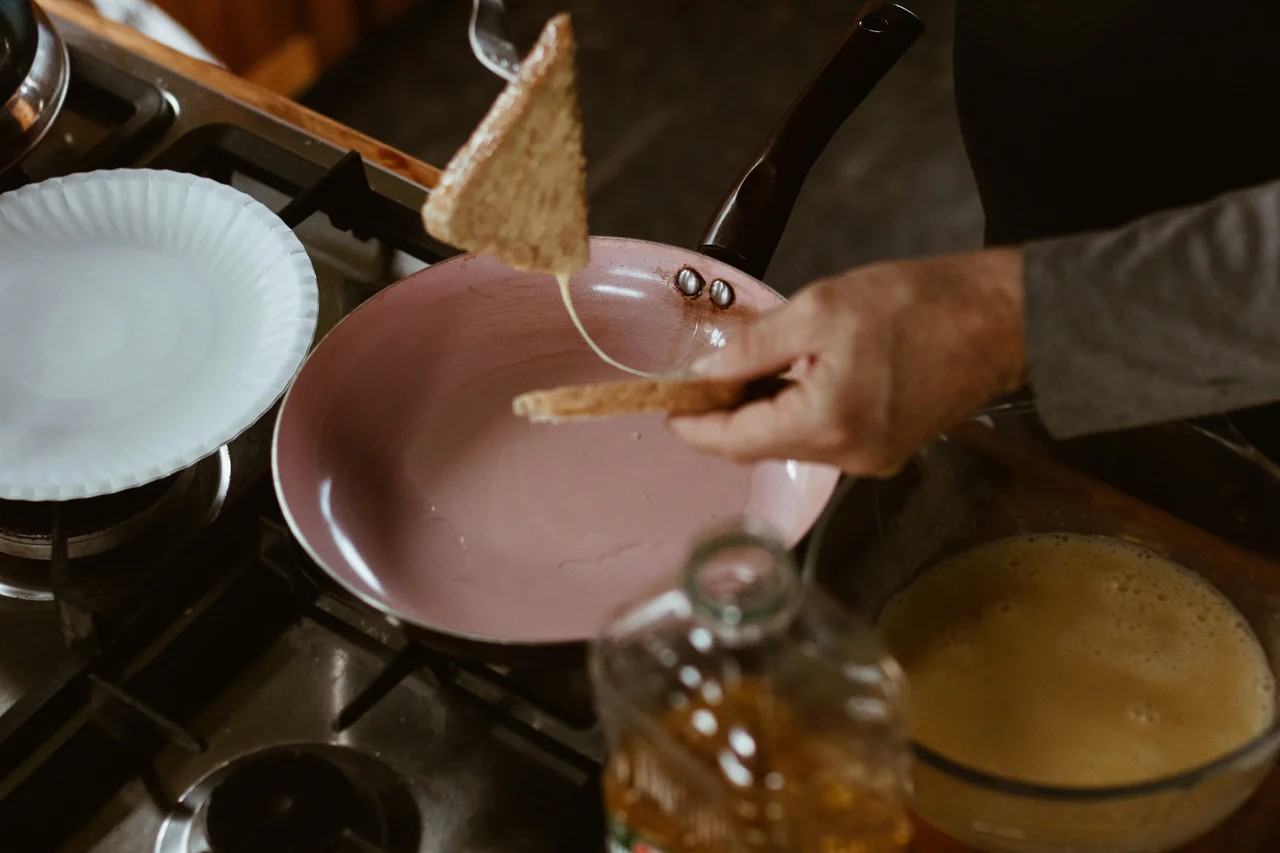
You crack an egg into a cold nonstick pan and it slides around like it’s on ice. No butter, no oil, no scrape. Just a pale grey surface that refuses to hold onto anything.
Why does that work? The coating is a polymer called PTFE, and it was discovered by accident in 1938 when a DuPont chemist found a gas cylinder that was empty but somehow heavier than it should be.
PTFE is a carbon chain sheathed in fluorine
The molecule is straightforward once you see it. PTFE is a long chain of carbon atoms, and each carbon is bonded to two fluorine atoms. The repeating unit is CF2-CF2, and it repeats thousands of times, according to a ScienceDirect overview of the polymer. The carbon-fluorine bond is one of the strongest in organic chemistry, and the fluorine atoms are large enough to form a tight, continuous sheath around the carbon backbone. That sheath is why almost nothing can react with it.
The fluorine coating also gives PTFE its defining physical property: a very low surface energy of about 18 dynes/cm and a coefficient of friction between 0.05 and 0.8, depending on the load. That is why food barely sticks to it. Food molecules can only form weak van der Waals interactions with the surface, not the stronger bonds they form with bare metal.
The practical temperature limit for continuous use is 260 °C. Above that, the polymer starts to degrade, and above 360 °C it releases gases that the German Federal Institute for Risk Assessment says are hazardous to health. So the nonstick property works beautifully, as long as you keep the pan below the temperature where the coating starts to come apart.
The accident that started it
Roy Plunkett was a chemist at DuPont’s Jackson Laboratory in New Jersey, working on new refrigerants. He and his assistant, Jack Rebok, were experimenting with tetrafluoroethylene gas stored in 1 kg canisters cooled with dry ice. On the morning of April 6, 1938, Plunkett asked Rebok to set up an experiment with one of the canisters from the day before. The valve opened, but no gas came out. The cylinder weighed the same as it had when full. Plunkett cut it open and found a white, waxy powder packed into the bottom and sides. The gas had polymerised inside the container, with the iron surface acting as a catalyst, according to the American Physical Society’s account of the discovery.
Plunkett realised he was looking at something new. The powder was chemically inert, heat resistant, and had very low friction. The first major use was not cookware. It was the Manhattan Project, where PTFE’s corrosion resistance made it useful as a coating on valves and seals in pipes handling uranium hexafluoride at the Oak Ridge enrichment plant.
The Teflon trademark was registered in 1945. The first PTFE-coated nonstick pan was invented in 1954 by French engineer Marc Grégoire, and the first nonstick cookware appeared in the US in 1961, introduced by Marion A. Trozzolo. By the 1960s, nonstick pans were in kitchens worldwide.
The manufacturing problem that changed the coating
The nonstick coating itself is inert. But making it required a processing aid called perfluorooctanoic acid (PFOA), a smaller PFAS molecule that was used as a surfactant during polymerisation. Residual traces of PFOA remained in the finished coating.
PFOA was linked to cancer and other health conditions, and after a class-action lawsuit involving 70,000 residents of the mid-Ohio Valley, the EPA forced DuPont to phase it out over ten years. By 2012, PTFE makers had phased out PFOA, according to Chemical & Engineering News. Nonstick cookware sold now should be PFOA-free.
The replacement processing aids, including GenX, have their own toxicity questions. The manufacturing of PTFE still involves PFAS molecules with uncertain risks, and that remains a live regulatory issue.
What the PFAS label means for a pan
PTFE belongs to the PFAS family, which is why it keeps showing up in regulatory discussions. But the polymer behaves very differently from the small PFAS molecules that dissolve in water and cross biological membranes. A PTFE molecule contains hundreds of carbon atoms, and it does not dissolve, does not bioaccumulate, and does not degrade under normal conditions. The EPA recognises these differences but still includes PTFE in its PFAS reporting rule to build a complete inventory of the chemical family.
The practical concern with a PTFE pan is not the coating in normal use. It is overheating. When a PTFE-coated pan is heated empty to 360 °C or above, the coating breaks down and releases invisible gases that can cause polymer fume fever, a temporary flu-like condition. Cases from home kitchens are rare. Cases from industrial manufacturing have been documented. The fumes are also fatal to birds, whose respiratory systems are much more sensitive than ours.
The same material in an operating theatre
PTFE’s inertness also makes it useful in medicine. Expanded PTFE, a porous form of the polymer, has been used in vascular grafts, hernia patches, and dental membranes for decades. The FDA has reviewed expanded PTFE membranes for guided tissue regeneration in dental procedures, where the material’s microporous structure allows tissue to grow into it without triggering an immune response.
The material that keeps eggs from sticking to a pan is the same material that can sit inside a human body for years without being rejected. That is not a coincidence. Both uses depend on the same property: almost nothing reacts with it.
What to do with the pan you already own
Keep it below 260 °C and it will keep working. That means you should never preheat an empty nonstick pan on high heat, especially on a gas or induction stove where the surface can climb past 360 °C in a couple of minutes. Cook with food in the pan, which caps the temperature near the boiling point of water until the water is gone. If you see the pan smoking while empty, turn it off.
A scratched pan still works as a pan, but the scratches expose the layer underneath. The BfR says swallowing tiny flakes of PTFE is not a health concern because the polymer is inert and passes through undigested. The bigger issue is that a scratched pan loses its nonstick property, and the exposed metal may start to stick.
If you want to avoid fluoropolymers entirely, ceramic coatings are an alternative, but they behave differently and that comparison depends on what you cook.
Quick questions
Sources
German Federal Institute for Risk Assessment (BfR). No adverse health effects to be expected from cookware with PTFE non-stick coating (opens in a new tab), bfr.bund.de, .
Supports the 360 °C decomposition threshold, the safety assessment for normal use, and the statement that ingested PTFE flakes are inert and excreted unchanged.
ScienceDirect. Poly(tetrafluoroethylene) (opens in a new tab), sciencedirect.com.
Supports the molecular structure, the carbon-fluorine bond strength, the surface energy of 18 dynes/cm, the coefficient of friction range, and the 260 °C continuous use rating.
American Physical Society. Discovery of Teflon (opens in a new tab), aps.org, .
Supports the April 6, 1938 discovery, the iron-catalysed polymerisation, the Manhattan Project first use, and the 1954 and 1961 nonstick pan dates.
Chemical & Engineering News. How does nonstick cookware work, and should you switch to 'green' pans? (opens in a new tab), cen.acs.org, .
Supports the PFOA phase-out by 2012, the manufacturing impact of PFAS processing aids, and the polymer fume fever description.
ScienceDirect. Thermal decomposition of fluoropolymers: Stability, decomposition products, and possible PFAS release (opens in a new tab), sciencedirect.com, .
Supports PTFE's thermal stability until 550 °C and the finding that no short- or long-chain PFAS were detected from heated PTFE.
U.S. Food and Drug Administration. Safety and Effectiveness: IMTEC/BIOBARRIER (opens in a new tab), accessdata.fda.gov.
Supports the medical use of expanded PTFE in vascular grafts, hernia patches, and dental membranes.