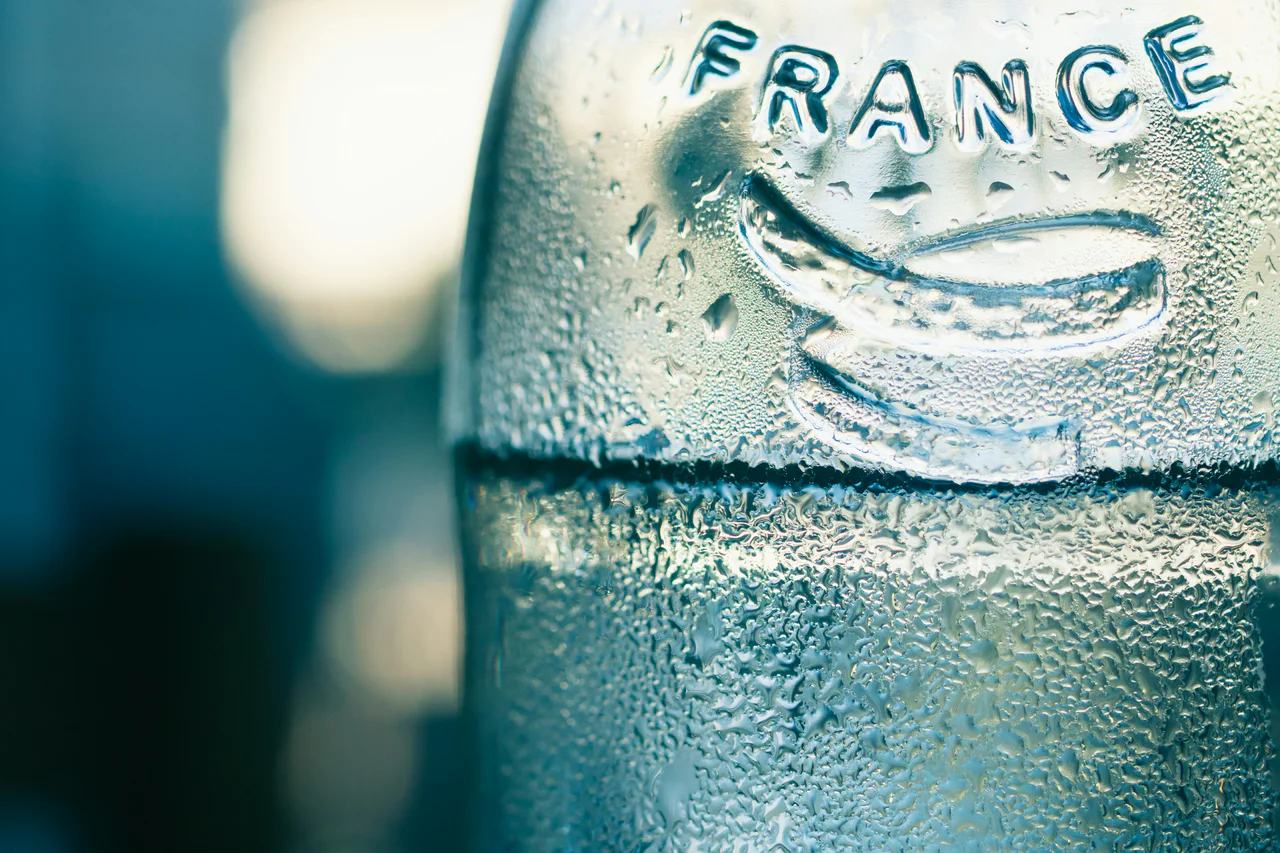
A 2023 preprint from Michigan State University in the United States found that putting beer bottles next to a freezer fan cut their cooling time by 60 to 70 percent, while a wet paper towel cut it by about 23 to 25 percent when airflow was low or blocked. If you have ever wrapped a warm bottle in a wet cloth, slid it into the freezer and kept checking the clock, you were relying on the smaller of those two effects. The researchers cooled glass beer bottles from about 21°C to 7°C in an industrial walk-in freezer, and the claim that a wet towel chills far less than moving air held up in those tests. Right next to the fan, the towel made a negligible difference.
Why would a wet towel help at all?
The idea is evaporation. Questacon, a science centre in Australia, explains that each water molecule leaving a wet paper towel carries a little energy away, and that a fan speeds up evaporation. Its demonstration uses water bottles in front of a fan at room temperature, so it says nothing yet about a freezer.
A freezer adds a complication. The Michigan State authors describe two camps: people who say evaporation pulls heat out of the drink, and people who say the towel acts as insulation. In 2012, Greg Blonder tested the second idea on his Genuine Ideas website. Before he added a fan of his own, a wine bottle in a moist towel on a freezer shelf was no faster than a plain bottle, and over the full hour it was slower. A single dry paper towel around a 1 litre water bottle almost doubled its freezing time. His explanation is that the towel adds mass that must also be cooled, and it traps insulating air.
That leaves two opposite results, and the gap between them is worth chasing.
So why do the tests disagree?
The Michigan State authors say earlier experiments often conflicted, and that many details matter. Their own set-up used four beers of one type in each condition, with bottles inside a closed bin, beside the bin, or next to the fan. In the bin and beside it, wrapped bottles started warmer yet reached drinking temperature at the same time as plain ones, which is where the 23 to 25 percent comes from.
Blonder used a different freezer, a wine bottle, thin plastic water bottles and cloth towels. The Michigan State work is also a preprint, a paper shared before formal journal review, and it covers one beer type in one kind of freezer. So the 23 to 25 percent describes that set-up and may not carry over to yours. Both sources do agree on what limits the cooling: the air around the bottle.
What does moving air do that a towel can’t?
Air is a poor conductor of heat. The Michigan State paper lists thermal conductivity, a measure of how fast a material passes heat along, for the materials in its model, using handbook values.
| Material | Thermal conductivity (watts per metre per kelvin) |
|---|---|
| Air | 0.0262 |
| Water | 0.5984 |
| Glass | 1.06 |
Dividing 0.5984 by 0.0262 gives about 23, so water passes heat along roughly 23 times as well as air. The glass and the beer pass heat easily, and the air is the slow step. Different materials moving heat at different speeds is also why metal feels colder than wood.
Still air makes the slow step slower. The team’s probes showed a warm layer forming outside a bottle with no airflow, and that layer cooled slowly, which shrank the temperature difference driving the heat flow. Infrared images showed warm air rising off the bottle even when it was shielded from the fan, drawing cooler air in behind it. With a fan, the warm layer was swept away and the bottle’s surface stayed in contact with air at freezer temperature.
A wet towel cannot remove that bottleneck. Blonder points out that the moist towel still has to hand its heat to the freezer’s air, and the Michigan State authors note that water needs a lot of energy to cool down. A wet towel adds a layer of water that must itself be cooled, and then it faces the same slow air.
Does a fan make the towel worth it?
In the Michigan State fan tests, bottles with and without a towel cooled much faster than anything in still air, and the towel made a negligible difference. Blonder’s fan test points the other way. He placed a small fan, about 15 cm across, in a nearly empty freezer, making an air current of about 6 km per hour. A 1 litre water bottle in a moist cotton towel cooled almost twice as fast as the same wrapped bottle in still cold air. It also cooled faster than a plain bottle with or without moving air. So the towel may add something once air is moving, though bottle material and towel type could account for the difference, and the biggest gain in both sources comes from the air.
One detail in Blonder’s account stands out. The towel froze within the first couple of minutes, yet the fan curve kept beating the still-air curve. He proposes that ice keeps shedding water vapour, a process called sublimation, and that the fan carries the vapour away, so a frozen towel may keep cooling the bottle. That explanation comes from his own writing, not from a journal, but it fits the Questacon description of moving air speeding up the loss of water from a towel.
What should you do with a warm bottle?
Nothing in these tests beat putting the bottle where cold air is moving. The Michigan State authors say the fastest spot is next to the incoming cold air near the freezer’s fan, and they suggest that turning the bottle now and then would speed cooling further, though they did not test it. They link their high-airflow set-up to an empty freezer and their no-airflow set-up to a fuller one, and Blonder notes that a freezer packed with food blocks air from circulating.
Freezer designs differ, and some models have no fan. To find where air moves in yours, hold a thin strip of tissue near the back wall and see where it flutters. For comparison, Blonder measured about 15 minutes for an ice-water bath to bring a wine bottle to serving temperature. In a freezer at about −26°C, he measured about half an hour to reach about 10°C, and in a fridge at about 1°C he measured about an hour and a half, all depending on the starting temperature. Whichever method you use, set a timer and check the bottle early, because a bottle forgotten in a freezer can freeze.
Short answers
Sources
Butts, D. and Murillo, M.. Cooling Beer with a Wet Paper Towel (opens in a new tab), qeios.com, .
Supports the 60 to 70 percent and 23 to 25 percent reductions in cooling time, the test conditions, the thermal conductivity values and the warm air layer around the bottle.
Blonder, G.. Chilling wine quickly (opens in a new tab), genuineideas.com, .
Supports the freezer shelf tests without an added fan, the fan test with a moist cotton towel, the sublimation explanation and the cooling times for ice water, freezer and fridge.
Questacon (Australia). Toilet roll cooler (opens in a new tab), questacon.edu.au.
Supports the explanation of evaporative cooling from a wet paper towel and the point that a fan speeds up evaporation in a room-temperature demonstration.