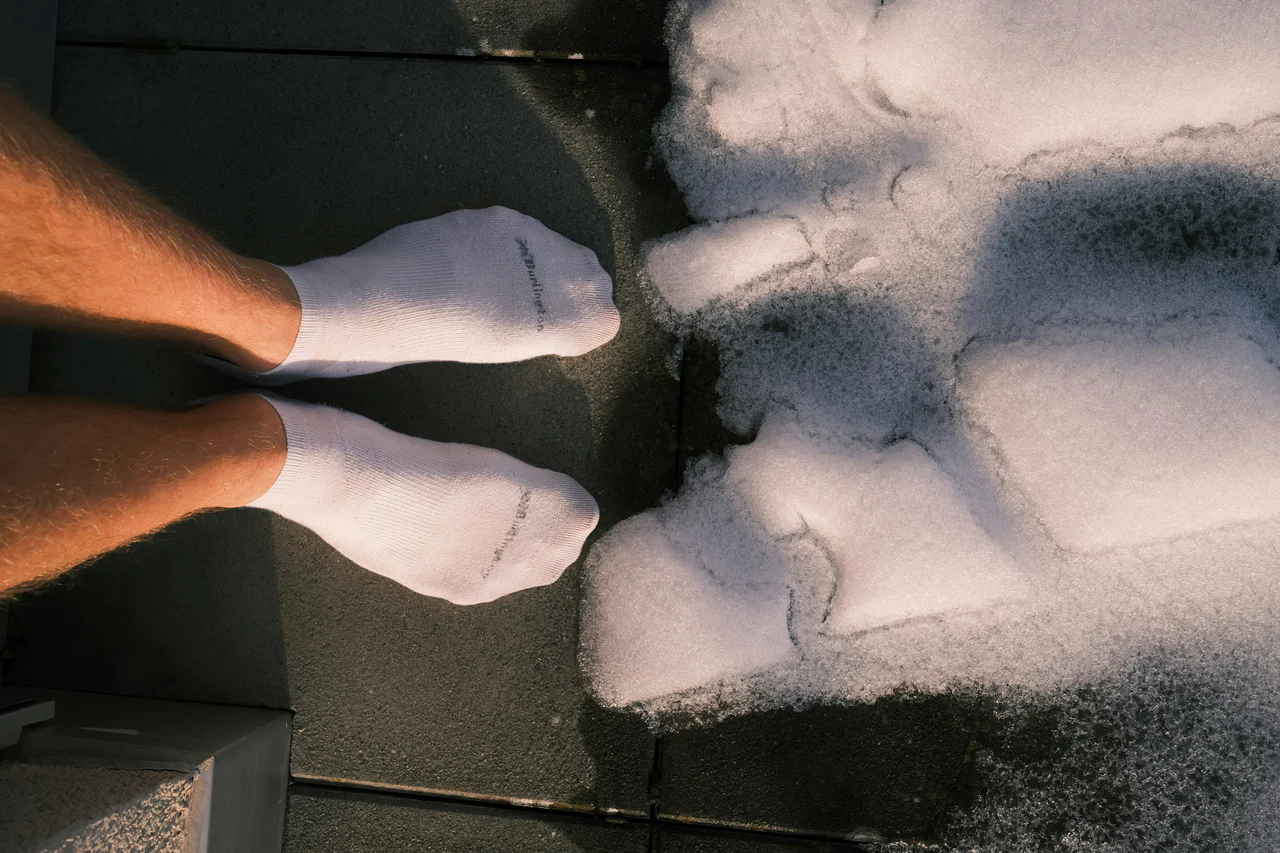
In a 2014 experiment at Loughborough University in the United Kingdom, 13 healthy male students rated water as wetter when it was cold than when it was warm or neutral, even though the moisture was the same. Now think of the moment your sock catches a splash of water and, within a second, you know it is wet without looking. If the skin has no sensor for wetness, what are you feeling?
Humans have no skin receptors for wetness, and cold plus touch can build the feeling
The claim holds, with limits. The 2014 study in the Journal of Neurophysiology by Davide Filingeri and colleagues begins from the point that humans are not provided with specific skin receptors for sensing wetness. It proposes that we learn to perceive wetness by blending thermal and tactile inputs. Its results fit that idea: cold-wet stimuli felt significantly wetter than warm-wet or neutral-wet stimuli with the same moisture content, and wetness perception fell when the activity of A-nerve fibres, which carry cold and touch information, was reduced. The result is a proposed model tested in small laboratory studies, and a follow-up found that cold is not always the main ingredient.
A splash touches the skin
The first cue is mechanical. Wet cloth can drag and cling, and skin reads that as touch. In a 2012 experiment by researchers in the Netherlands, people judged how wet pieces of fabric were. Holding still gave only thermal cues, while moving the fingers added mechanical cues. Performance is measured with a Weber fraction, the smallest relative difference people can detect, where smaller is better. Moving gave about 0.3, and holding still gave 0.34 to 0.63. People judged wetness better when the fabric could drag and cling. Stickiness is a friction effect between skin and surface, a topic we cover for dry glass in our post on fingerprint ridges and friction.
Water pulls heat from the skin
The second cue is temperature. Cold stimuli drew the strongest wetness ratings in the 2014 study. A 2013 experiment from the same group went further and applied six cold but dry stimuli to the forearms of 9 women. Five of the 9 perceived wetness, and 4 did not perceive wetness at all, so a dry cold object can feel wet, but not to everyone. Materials that pull heat from the skin quickly feel cold for the reason covered in our post on why metal feels colder than wood.

Here is how the four experiments in this post compare:
| Experiment | Who | What was applied | What happened |
|---|---|---|---|
| Filingeri et al., 2014, Journal of Neurophysiology | 13 healthy male students | Warm, neutral and cold wet stimuli on forearm and fingertip, with and without a nerve block | Cold-wet felt wetter, the nerve block reduced wetness perception, and the forearm was more sensitive than the fingertip |
| Filingeri et al., 2013, Neuroscience Letters | 9 women | Six cold but dry stimuli on the forearm | 5 of the 9 perceived wetness and 4 did not |
| Filingeri et al., 2014, Skin Research and Technology | 7 participants aged 21 ± 2 years | Wet and dry stimuli 4 and 8 °C above skin temperature on the back | The wetness threshold was never reached |
| Bergmann Tiest et al., 2012, Acta Psychologica | People judging wet fabrics | Holding still against moving the fingers | Weber fractions of about 0.3 when moving, 0.34 to 0.63 when still |
Nerve fibres carry both messages
The 2014 study used an inflatable compression cuff, the kind used to measure blood pressure, to dull A-nerve activity, and wetness perception was significantly reduced. The authors suggest that the A-nerve fibres, which carry both cold and touch signals, might be the route by which the two ingredients reach the brain.
Hairy forearm skin was more sensitive to wetness than hairless fingertip skin. The researchers had predicted this, because hairy skin is more sensitive to thermal stimuli while hairless skin is more sensitive to tactile ones. Hairy skin, the kind with hair follicles, is also where goosebumps form.
The brain concludes it is wet
The 2014 authors built their model on perceptual learning and Bayesian perceptual inference. In plain terms, the brain weighs incoming signals against what past experience says they usually mean, and cold plus a clinging feel has usually meant something wet.
Warm water shows the other side. In a 2014 experiment in Skin Research and Technology, wet and dry stimuli 4 and 8 °C above skin temperature were applied to the backs of 7 participants. The threshold for clearly perceived wetness, “slightly wet” on the scale, was never reached, and participants did not perceive that some of the stimuli were wet. The authors conclude that during initial contact it is not the moisture itself but the integration of sensory inputs, with coldness seeming dominant, that drives the perception of wetness. So cool water and a clinging sock can tell the brain wet within a second, while a warm splash can pass unnoticed at first contact.
How the ingredients are weighted is still open. The 2014 authors say the individual roles of thermal and tactile cues, and how the nervous system integrates them in the skin and the brain, are still poorly understood. The 2013 study adds that cold is not always of primary importance, and that touch, vision and differences between people might be equally decisive.
Short answers
Sources
Filingeri, D. et al.. Why wet feels wet? A neurophysiological model of human cutaneous wetness sensitivity. (opens in a new tab), eprints.soton.ac.uk, .
Supports the absence of specific wetness receptors, the learned blend of thermal and tactile inputs, cold-wet stimuli feeling wetter, the nerve block result and the model built on perceptual learning and Bayesian inference.
Neuroscience News. Why Wet Feels Wet: Understanding the Illusion of Wetness (opens in a new tab), neurosciencenews.com, .
Supports the 13 male students, the Loughborough University setting, the compression cuff method, A-nerve fibres and hairy skin being more sensitive than hairless skin.
Filingeri, D. et al.. The role of decreasing contact temperatures and skin cooling in the perception of skin wetness. (opens in a new tab), eprints.soton.ac.uk, .
Supports 5 of 9 women perceiving wetness from cold dry stimuli, the cooling rates and cold not always being of primary importance.
Filingeri, D. et al.. Warm temperature stimulus suppresses the perception of skin wetness during initial contact with a wet surface (opens in a new tab), eprints.soton.ac.uk, .
Supports the 7 participants, the stimuli 4 and 8 °C above skin temperature, the wetness threshold never being reached and coldness seeming dominant.
Bergmann Tiest, W. M. et al.. Haptic perception of wetness (opens in a new tab), research.vu.nl, .
Supports the Weber fractions of about 0.3 for moving touch and 0.34 to 0.63 for holding still.
Shibahara, M. et al.. Relative sensation of wetness of different materials (opens in a new tab), research.vu.nl, .
Supports materials that cool the skin quickly feeling relatively wet and stickiness causing a wet sensation at room temperature.
Filingeri, D. et al.. Tactile cues significantly modulate the perception of sweat-induced skin wetness independently of the level of physical skin wetness (opens in a new tab), pmc.ncbi.nlm.nih.gov.
Supports tactile cues modulating the perception of sweat-induced wetness and coldness and stickiness being read as a sign of moisture.