Your fingertip slides across a glass screen when you try to grip it, even though the skin there is covered in tiny raised ridges. It has long been assumed that those ridges improve grip, and a slippery pane of glass makes you wonder.
In a 2009 laboratory test on dry acrylic glass, fingertip ridges cut the skin’s contact area by about one-third and friction rose with contact area, so the claim holds there, but later work finds that sweat trapped under the ridges can raise friction on glass within tens of seconds.
Why only part of the fingertip touches the glass
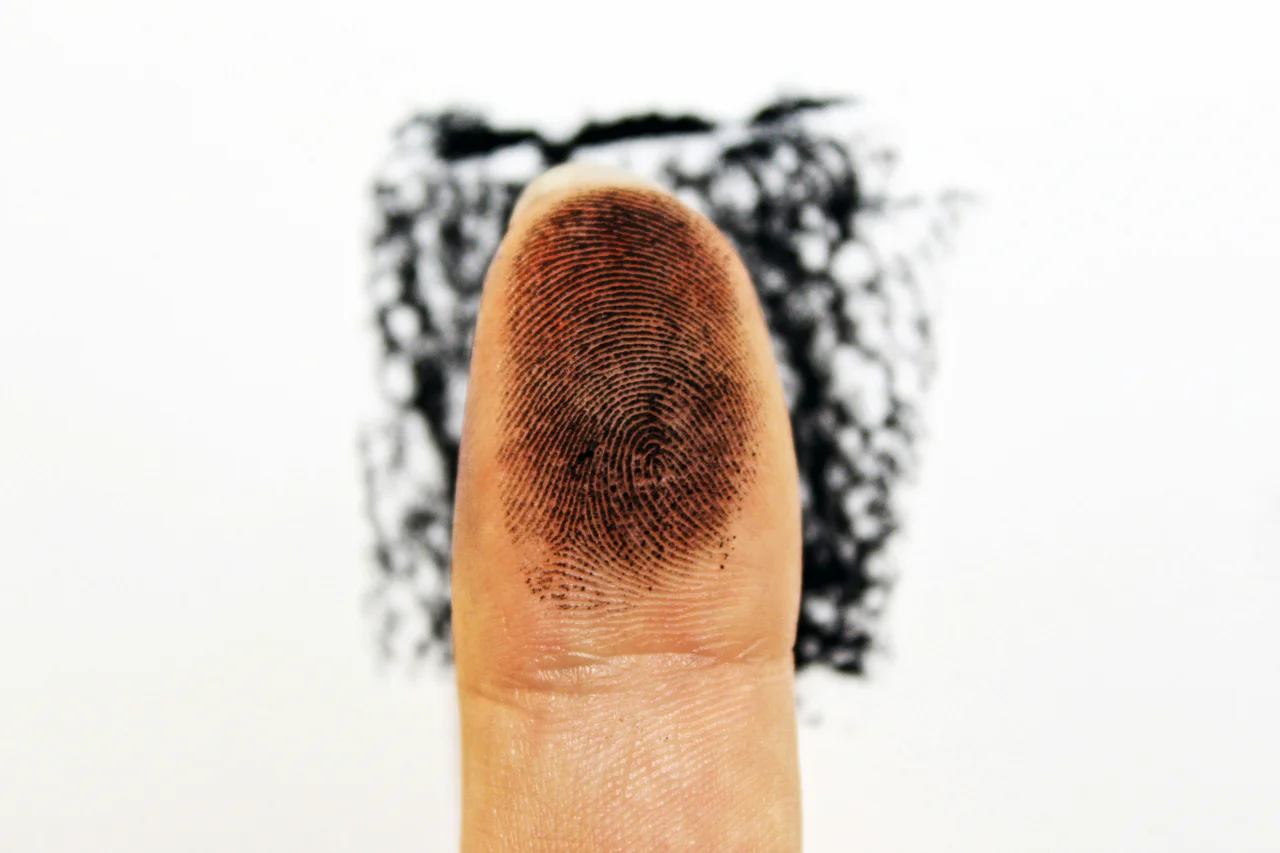
Peter Warman and Roland Ennos, two researchers in Manchester, UK, took ink prints of fingertips pressed against an acrylic glass test rig. The ridges touched the glass. The troughs between them did not. Across nine test setups, the touching area averaged about two-thirds of the pad’s full outline, so the ridges removed about one-third of the possible contact. The fingers belonged to Warman himself, so the numbers come from one person.
How fingertip friction follows contact area
For a hard solid such as metal, friction rises in proportion to how hard two surfaces are pressed together, and contact area matters little. The fingertips did not follow that rule. The tests used each finger of the right hand, the index finger at different angles, and acrylic strips of different widths, which let the authors separate the effect of pressing force from the effect of contact area. The friction coefficient, the ratio of sliding force to pressing force, fell as pressing force rose. Friction was higher when a finger lay flatter or the strip was wider, since both give more contact area. The authors concluded that fingertips behave more like rubber, where friction depends on contact area.
The paper’s rounded figures for flat fingers show the size of the effect. Friction force equals the coefficient times the pressing force.
| Pressing force | Friction coefficient reported | Friction force (calculated) |
|---|---|---|
| 0.03 N | about 3 | about 0.09 N |
| about 1 N | about 1 to 1.5 | about 1 to 1.5 N |
Pressing force rose about 33 times, from 0.03 N to 1 N, while friction rose only about 11 to 17 times. A hard solid would have risen 33 times. Because friction followed contact area, the authors reasoned that ridges, which remove one-third of that area, should lower friction on dry, smooth acrylic.
A test on one volunteer’s fingers
The measurements come from one volunteer, one dry material, and a slow pull of 100 mm per minute with pressing forces from 0.03 to 1.64 N. The authors also say their ink method probably overestimated the true contact area, and that the rubber model cannot be properly tested until contact area is measured better. Their data fit neither the hard-solid model nor the rubber model completely.
A press release from the journal’s publisher, The Company of Biologists, was headed with the statement that fingerprints do not improve grip friction, and it called the grip idea “just another urban myth”. The paper’s own title is more careful. It calls fingerprints unlikely to increase fingerpad friction.
What changes in the first tens of seconds
A 2013 review in the Journal of the Royal Society Interface, led by Michael Adams at the University of Birmingham in the UK, adds time to the picture. Its authors say the contact of a finger pad is governed by the ridges and by sweat released from pores on those ridges. On an impermeably smooth surface such as glass, the friction coefficient can rise by an order of magnitude, roughly ten times, over tens of seconds. On a porous surface such as paper it falls. The authors attribute the rise to occlusion, which means sweat becoming trapped between the skin and the surface.
How sweat changes the skin
A 2020 study in PNAS, by a team that included researchers at Seoul National University in South Korea and the University of Birmingham, asked why. Its authors report that on an impermeable surface, sweat blocked in the ridges softens the skin, and that dramatically increases friction. Too much water could instead form a fluid layer and cause slipping.
Using terahertz and infrared imaging, the authors propose that two mechanisms keep moisture near an optimum, whether the fingertip starts wet or dry. One is evaporation along the narrow furrows. The other is the blocking of sweat pores. In that proposal, the furrows that left one-third of the pad out of contact in the first test also carry out part of the moisture control. The abstract lists lower friction on smooth surfaces as one of several arguments made about the ridges, so the dry-glass result sits inside a debate that is still open.
What your fingertip does on a glass screen
Put the pieces together and glass gives a fingertip two phases. At first the ridges limit how much skin touches, which can lower friction on dry smooth surfaces such as acrylic glass. With time, trapped sweat softens the skin and friction can climb. A quick grab at a screen gives that second phase little time, which fits the slip you noticed, although that is an inference from the laboratory results. Skin moisture, the glass and the air all vary, so the difference may be large or small for you. To see it, press a clean, dry fingertip on a pane of glass and try one short slide straight away, then hold the same fingertip still for about half a minute and slide again, noticing whether the second slide feels grippier.
Short answers
Sources
Warman, P. H., et al.. Fingerprints are unlikely to increase the friction of primate fingerpads (opens in a new tab), journals.biologists.com, .
Reports the one-third reduction in contact area on dry acrylic glass, the rubber-like dependence of friction on contact area, the test conditions and limits, and the other proposed roles for fingerprints.
Adams, M. J., et al.. Finger pad friction and its role in grip and touch (opens in a new tab), research.birmingham.ac.uk, .
Supports the statement that friction on glass can rise by an order of magnitude over tens of seconds, falls on porous surfaces such as paper, and is attributed to an occlusion mechanism involving sweat.
Yum, S.-M., et al.. Fingerprint ridges allow primates to regulate grip (opens in a new tab), research.birmingham.ac.uk, .
Supports the proposal that trapped sweat softens the skin and raises friction on impermeable surfaces, and that evaporation along the furrows and pore blocking regulate moisture.
The Company of Biologists. Fingerprints do not improve grip friction (opens in a new tab), m.phys.org.
Shows how the 2009 result was summarised in a press release, including the urban myth wording and the one volunteer's fingers used in the test.