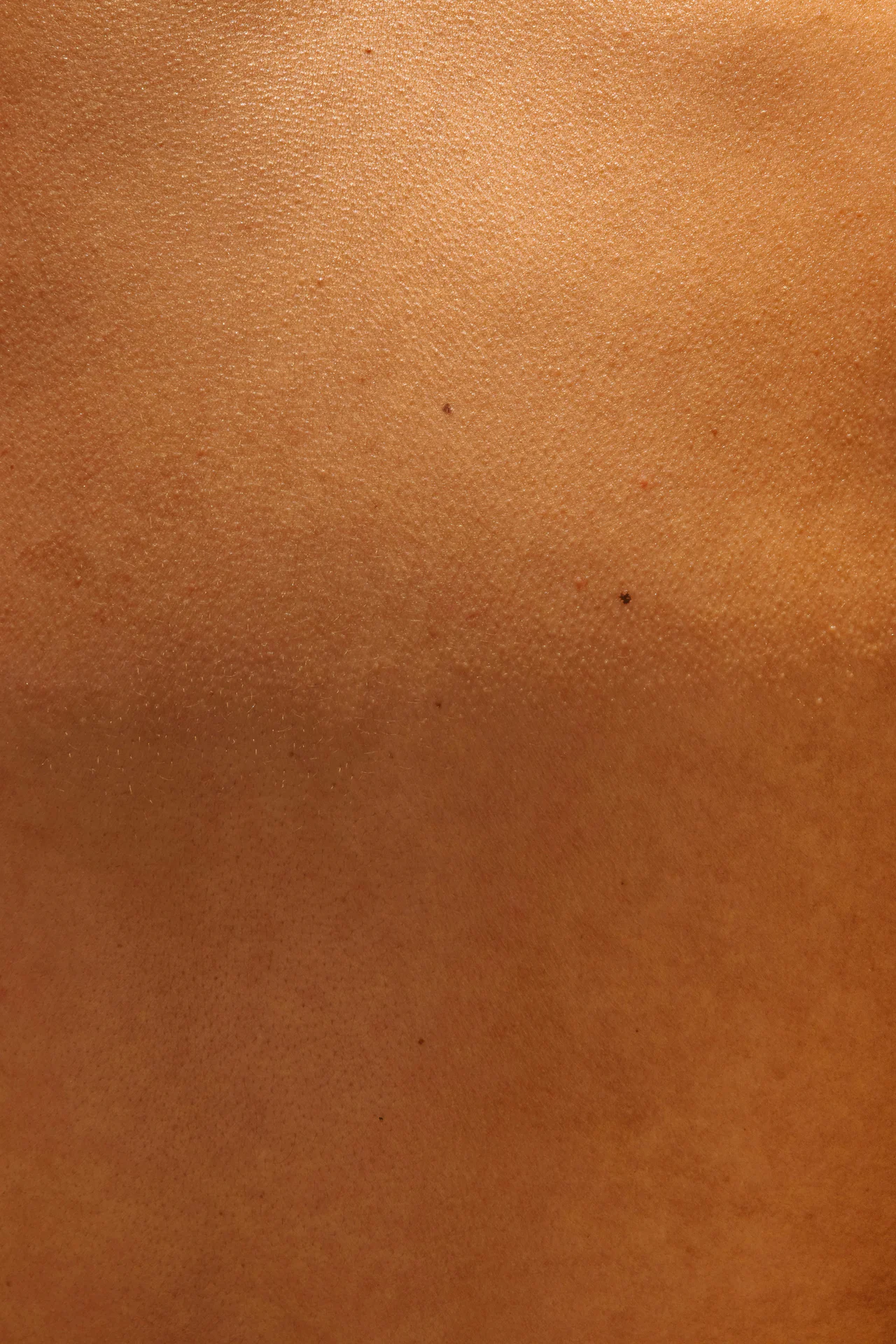
A single arrector pili muscle in human facial skin is about 1,657.9 micrometres long, sits roughly 943.6 micrometres below the surface, and branches about 1.6 times, according to a 2025 three-dimensional microscopy study published in Scientific Reports. That tiny smooth muscle is what pulls your hair upright when you’re cold or scared, creating the bump you call a goosebump. A 2020 study in the journal Cell found that the same muscle also acts as a bridge between sympathetic nerves and the stem cells that regenerate hair. That dual role explains why the reflex survived millions of years of evolution even though humans barely have enough body hair to benefit from it.
The muscle Darwin wrote about
Charles Darwin discussed goosebumps in The Expression of the Emotions in Man and Animals, published in 1872. He compared the bristling fur of a frightened dog to the human scalp reaction during fear, recognizing it as a shared mammalian reflex rather than a human quirk.
The muscle responsible is the arrector pili. It’s a smooth muscle bundle that attaches to the bulge region of the hair follicle and extends up to the upper dermis. When it contracts, it pulls the hair into a more upright position. The 2025 Scientific Reports study used serial block-face scanning electron microscopy to map its structure in human skin. The numbers above come from that study.
The nerve supply is dense. Sympathetic nerve fibers wrap around the muscle, and when they fire, the muscle contracts. That’s why goosebumps are involuntary. You can’t decide to raise your arm hair any more than you can decide to dilate your pupils.
Why the reflex is older than us
For a mammal with thick fur, piloerection does two things. It traps a layer of air between the hairs, which insulates the body against cold. And it makes the animal look larger, which is useful when facing a threat. A cat does this when it puffs up. A porcupine does it with its quills.
Humans have fine vellus hair over most of the body, not the thick coat our ancestors had. The Smithsonian’s Human Origins Program puts it plainly: the body hair of all mammals stands up when cold, creating a layer of warmth, and when we’re cold the muscles around the hair follicles contract. That reflex is left over from when our ancestors had long body hair. Since we don’t have much body hair, all we see are the bumps on our skin.
The reflex persisted even after the fur that made it useful was mostly gone.
The 2020 finding that gave it a second job
For decades, the story was that goosebumps were vestigial, a leftover with no function in humans. A 2020 study led by Ya-Chieh Hsu at Harvard and Sung-Jan Lin at National Taiwan University found something else.
The researchers used electron microscopy to look at hair follicles in mice. They found that the sympathetic nerve didn’t just connect to the arrector pili muscle. It also formed synapse-like contacts directly with hair follicle stem cells, the cells that regenerate hair. The muscle acted as a bridge that maintained the nerve’s connection to those stem cells.
When the researchers removed the muscle, the nerve-stem cell connection broke, and hair regeneration slowed. When they exposed mice to cold, the cold triggered goosebumps in the short term, and then activated the stem cells to produce new hair over the following weeks. Mice kept in the cold started producing new hair from their stem cells in less than two weeks.
The dual role explains why the reflex survived. It isn’t just a leftover. The same circuit that raises your hair also tells your follicles when it’s time to grow.
What the names mean
The medical term for goosebumps is cutis anserina. Cutis means skin, and anser means goose. Harvard Health notes the similarity in texture is close enough to goose skin that the name stuck. Other terms include horripilation, piloerection, and pilomotor reflex. The reflex is called the pilomotor reflex because the arrector pili muscles are sometimes called pilomotor muscles.
The common name is goosebumps. Goose pimples and goose flesh are variations. All of them describe the same physical event: a tiny muscle contracting and pulling a hair upright.
When goosebumps aren’t just a chill
Most of the time, goosebumps are harmless. Cold triggers them, strong emotions trigger them, and a piece of music can trigger them. A systematic review published in 2022 in the International Journal of Psychophysiology found that emotional piloerection is associated with sympathetic activation, including increased skin conductance and heart rate.
But there are situations where persistent goosebumps mean something else. Cleveland Clinic lists several conditions where goosebumps can be a symptom: keratosis pilaris, anxiety disorders, withdrawal from opioids or alcohol, and seizures. Ictal piloerection, or goosebumps that happen as part of a seizure, is rare. A 2004 case report in Clinical Neurophysiology described a 26-year-old woman with right mesial temporal sclerosis whose seizures consisted of repetitive piloerection, cold shivers, and tachycardia. The events occurred about once every 15 minutes.
If you’re getting goosebumps repeatedly without a clear trigger, especially with other symptoms like a racing heart, confusion, or a change in consciousness, that’s a reason to see a doctor.
What to notice next time
The next time your arm prickles in a cold room or during a song, you’re feeling a circuit that’s been in mammals for tens of millions of years. The muscle is doing what it always did: pulling hair upright, trying to trap air, making you look slightly larger than you are. The nerve is doing something else too, talking to the stem cells in your hair follicles.
That’s the part that was hidden until a microscope in a Harvard lab picked it out. The reflex didn’t disappear because it stopped being useful. It stuck around because it had a second job.
Short answers
Sources
National Institutes of Health. What goosebumps are for (opens in a new tab), nih.gov, .
Supports the 2020 Cell study summary, the arrector pili muscle's role, and the cold-induced hair growth timeline in mice.
Shwartz, Y. et al.. Cell Types Promoting Goosebumps Form a Niche to Regulate Hair Follicle Stem Cells (opens in a new tab), Cell, .
Supports the dual-component niche, the synapse-like connections between sympathetic nerves and hair follicle stem cells, and the muscle's role as a bridge.
Elisa, S. et al.. The physiological study of emotional piloerection: A systematic review and guide for future research (opens in a new tab), International Journal of Psychophysiology, .
Supports the association between emotional piloerection and sympathetic activation, including increased skin conductance and heart rate.
Scientific Reports. Three-dimensional ultrastructural analysis of human skin with the arrector pili muscle interacting with the hair follicle epithelium (opens in a new tab), nature.com, .
Supports the 3D anatomy measurements of the arrector pili muscle: 1,657.9 μm length, 943.6 μm depth, 1.6 branches, 28.8-degree angle.
Cleveland Clinic. Why You Have Goosebumps on Your Skin (opens in a new tab), health.clevelandclinic.org, .
Supports the list of medical conditions where goosebumps can be a symptom, including keratosis pilaris, anxiety, withdrawal, and seizures.
Harvard Health Publishing. Wondering about goosebumps? Of course you are (opens in a new tab), health.harvard.edu, .
Supports the terminology (cutis anserina, horripilation, piloerection) and the fight-or-flight description.
Smithsonian Human Origins Program. Why do we get goose bumps? (opens in a new tab), humanorigins.si.edu.
Supports the vestigial reflex explanation and the layer-of-warmth mechanism in mammals with thick fur.
Clinical Neurophysiology. Acute repetitive pilomotor seizures (goose bumps) in a patient with right mesial temporal sclerosis (opens in a new tab), sciencedirect.com, .
Supports the case report of pilomotor seizures occurring every 15 minutes in a 26-year-old woman with right mesial temporal sclerosis.
Schoeller, F. et al.. Repeated exposure decreases aesthetic chills likelihood but increases intensity (opens in a new tab), PLOS ONE, .
Supports the finding that repeated exposure decreases chills likelihood but increases intensity, and the demographic variability in chill responses.