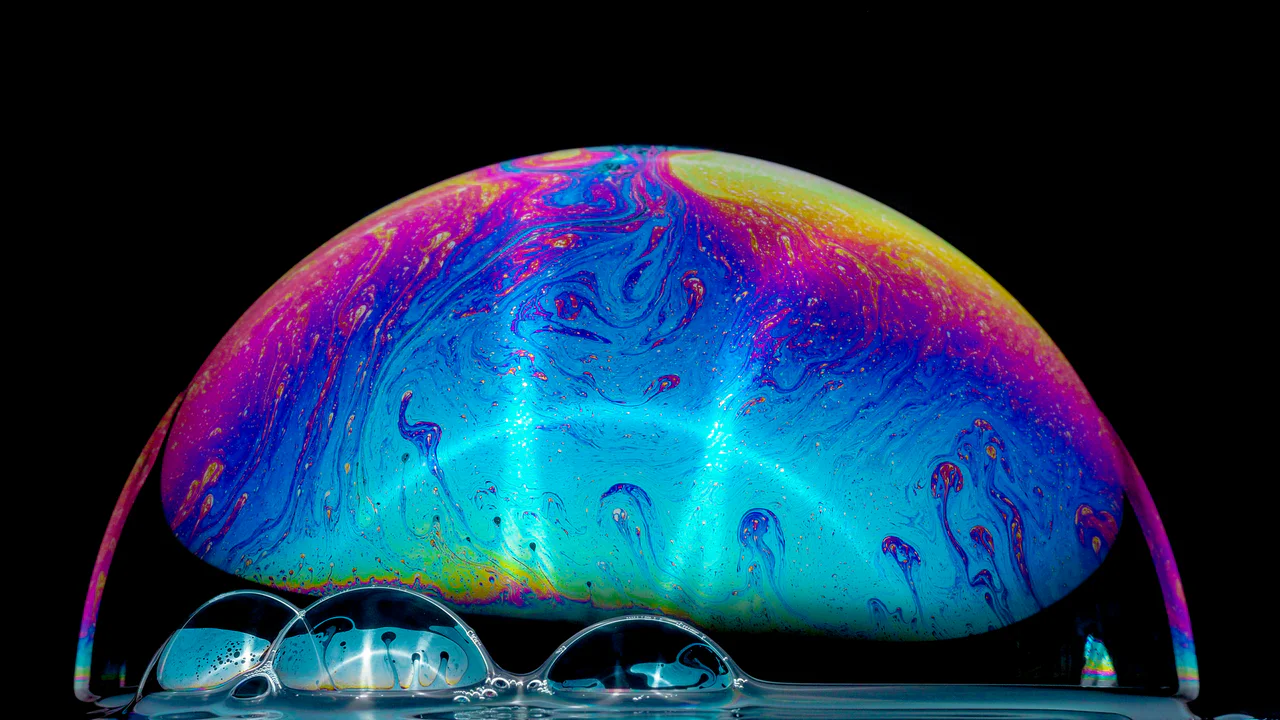
A drifting bubble shimmers in bands of colour, and near its top a patch opens that reflects almost nothing. It looks like a hole, though the bubble is still whole around it.
What a black patch tells you
The claim partly holds. In white light, a black patch on a soap film marks a film thinner than about 36 nm, which is far too thin to be sturdy, and two of the sources below say a film that goes black is about to burst. Laboratory studies add that isolated black films can be stable for a while, and that disturbed bubbles can burst before any black appears.
Why does a thin film shimmer in colours?
A bubble wall reflects light twice, once from its outer surface and once from the inner one. Archana Ghode of IIT Madras in India explains on a Chennai science page that the colour you see depends on how the two reflected waves line up. Where crests meet crests, that colour is enhanced, and where a crest meets a trough, it cancels. Different colours have different wavelengths, so different thicknesses enhance different colours, and none of the colour comes from the soap.
Keith Gibbs of schoolphysics in the United Kingdom writes the extra path of the second wave as 2nt cos r, with n the refractive index, t the thickness and r the angle of the light inside the film. A soap film in air also flips the wave at its first face. At normal incidence a colour is reinforced when its wavelength equals 4nt ÷ (2m + 1), with m = 0, 1, 2 and so on. With his index of 1.33, the table gives his values:
| Film thickness | Reinforced visible wavelengths | What you see |
|---|---|---|
| 100 nm | 4 × 1.33 × 100 = 532 nm (m = 0) | green only |
| 1,000 nm | 591 nm (m = 4) and 475 nm (m = 5) | yellow and blue |
| 10,000 nm | 24 wavelengths, from m = 36 to m = 59 | nearly white |
Thick films reflect light without showing colour. A CD makes colour differently, through diffraction from regular track spacing, as our CD rainbow post explains. So what happens to the colours as a film thins?
Why would the colours drain away to black?
Water in the wall runs downward. For a film that is not horizontal, R. J. Pugh’s chapter in the Cambridge book Bubble and Foam Chemistry says gravity acts directly, so the top thins first. Pugh quotes Isaac Newton’s 1675 paper, which describes small black spots rising up the sides of a bubble to join a larger black spot at the top. Robert Hooke first took such spots for holes.
As the wall thins, the extra path shrinks. Gibbs says the two reflected waves end up almost exactly out of phase, so they cancel and the film reflects almost no light. Ghode adds that once the wall is much thinner than the wavelength of visible light, all the visible waves cancel.
How thin is black?
The OpenStax College Physics problem, solved by Shaun Dychko on College Physics Answers, sets a cut-off: the film looks dark when its path difference is below a quarter of the wavelength. It then asks for the thickest film that is dark at every visible wavelength:
| Step | Value |
|---|---|
| Condition | 2nt < λ ÷ 4, so t < λ ÷ (8n) |
| Shortest visible wavelength used | 380 nm |
| Refractive index of water-like film | 1.333 |
| Thickest dark film | 380 ÷ (8 × 1.333) = 35.6 nm |
The quarter-wavelength cut-off is the problem’s own assumption. Pugh gives the thinnest stable black film, the Newton black film, as about 4 nm, roughly the thickness of two layers of soap molecules.
So does black mean it pops right now?
Gibbs says a film that goes black is about to burst, Ghode says the bubble soon pops, and the textbook solution says a film that thin will pop with the slightest breeze. Pugh’s chapter shows the other side. In studies of isolated films 0.05 to 1.0 mm across, held with precautions against vibration, black spots spread until the whole film is black. Hooke and Newton noticed that thinning stopped at that point and the film collapsed only later. Pugh explains that repulsive forces between the surfaces can hold a black film in a stable state, and foams made with black films can last more than 10 minutes.
The reverse also happens. For two bubbles meeting in motion, Pugh reports calculated rupture thicknesses of 5 to 12 micrometres, far above the 100 nm or less seen in still lab films. A disturbed bubble can therefore pop long before it turns black.
To see the sequence safely, dip a wire ring in soap solution, hold it upright in bright light and watch its top edge: bands of colour slide down, black spreads from the top, and a gentle breath, as Gibbs notes, makes the patterns swirl.
Still wondering
Sources
Pugh, R. J.. Soap bubbles and thin films (opens in a new tab), rpc-cms-re4-upscope.web.cern.ch.
Supports black spots spreading in thinning films, Newton and Hooke's observations, stable black films of about 4 nm, still-film and dynamic rupture thicknesses, drainage by gravity, soap stabilising films and swirling colours.
Ghode, A.. The light and colour of soap bubbles (opens in a new tab), imsc.res.in.
Supports colours coming from interference between two reflections, all visible waves cancelling in a very thin wall, the bubble popping soon after and the dye question.
Gibbs, K.. Interference in thin films (opens in a new tab), schoolphysics.co.uk.
Supports the path difference formula, the reinforced wavelengths at 100 nm, 1,000 nm and 10,000 nm, the cancelling of very thin films and the statement that a black film is about to burst.
Dychko, S.. (a) As a soap bubble thins it becomes dark, because the path length difference becomes small compared with the wavelength of light and there is a phase shift at the top surface (opens in a new tab), collegephysicsanswers.com.
Supports the quarter wavelength criterion, the 35.6 nm thickest dark film for an index of 1.333 and the statement that such a bubble pops with the slightest breeze.