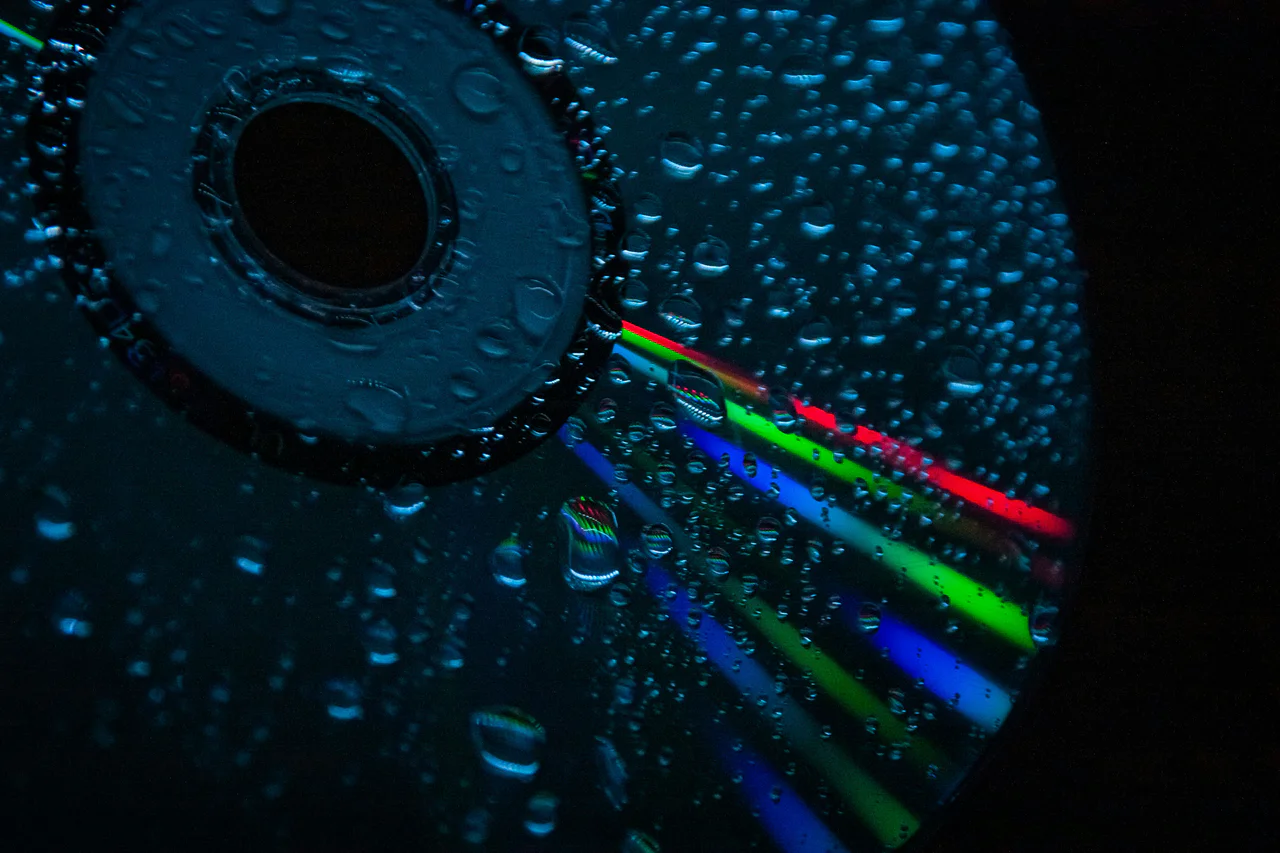
The spiral track on a compact disc is spaced about 1.6 micrometres apart, only about 2 to 4 times the wavelength of visible light, which the Institute of Mathematical Sciences in Chennai, India, puts at roughly 0.4 to 0.7 micrometres. Tilt a disc under a lamp and that spacing sends bands of colour sliding across its shiny side. A mirror-like layer should reflect white light as white, so where do the colours come from?
The headline holds: reflections from neighbouring tracks interfere, so each colour leaves the disc at its own angle and white light spreads into a spectrum.
Why would a mirror-like layer make colours?
The shiny side is not smooth. According to the same Chennai page, a CD stores data as a spiral of microscopic pits and flat stretches pressed into polycarbonate plastic, then coated with a reflective aluminium layer. The turns of that spiral sit about 1.6 micrometres apart, a spacing that OpenStax, an open textbook from Rice University in the United States, and HyperPhysics, a reference from Georgia State University in the United States, both give.
Light bouncing off one turn and light bouncing off the next travel slightly different distances to your eye. For a viewing angle θ, the difference is d × sinθ, where d is the 1.6 micrometre spacing. Where that difference equals a whole number of wavelengths, the two reflections reinforce each other and you see a bright reflection. Each colour has its own wavelength, so each colour reinforces at its own angle.
A regular pattern that spreads light this way is called a diffraction grating. OpenStax notes that gratings work for reflection as well as transmission, and it lists a CD, an Australian opal and butterfly wings as examples. The Chennai team adds that the colours are not in the disc itself. Light creates them.
That explains why the colour depends on angle. It does not yet say how big the angles are.
How far apart are the colours?
The rule above is usually written d sinθ = mλ, where λ is the wavelength and m is the order, a whole number that counts bright bands outward from the centre. With d = 1,600 nanometres and light arriving straight on at the disc, sinθ equals mλ divided by 1,600. Here are the steps for three colours, using round wavelengths inside the 0.4 to 0.7 micrometre range:
| Colour | Wavelength (nm) | First order: sinθ = λ ÷ 1,600 | First order angle | Second order: sinθ = 2λ ÷ 1,600 | Second order angle |
|---|---|---|---|---|---|
| Violet | 400 | 0.250 | 14.5° | 0.500 | 30.0° |
| Green | 550 | 0.344 | 20.1° | 0.688 | 43.4° |
| Red | 700 | 0.438 | 25.9° | 0.875 | 61.0° |
As a check, HyperPhysics gives about 22° for 600 nm red light in first order. The same steps give sinθ = 0.375, which is 22.0°.
Longer wavelengths land at larger angles, and second-order bands spread much wider than first-order ones. A lamp that shines at an angle instead of straight on shifts all of these numbers, so the table shows the shape of the pattern, and exact angles depend on where your lamp sits.
Why do I only see one band at a time?
Your eye sits at one angle, so it receives only the wavelengths that reinforce there. The Chennai page explains that tilting the disc shifts which wavelength is reinforced at your viewing angle, which is why the colour changes as you move it.
The lamp’s own glare follows the same rule. When m is 0, sinθ is 0 for every wavelength, so all the colours leave in the same direction and add up to white. OpenStax draws this layout for white light on a grating: a white central maximum with rainbows on either side, fainter in second order than in first. Violet sits nearest the white centre and red farthest, which matches the table.
Light of a single wavelength, such as the red helium-neon laser in the HyperPhysics example, gives separate bright spots in each order instead of a band of colours. The rainbow needs white light.
Is the rainbow part of how a CD works?
OpenStax calls the colours incidental to how a disc stores and retrieves data. The grooves are one continuous groove spiralling outward from the centre, data are recorded along it as binary code in small pits, and a laser follows the groove while a photodiode detector catches its reflection.
Diffraction does turn up inside the player, though. OpenStax explains that a diffraction grating creates the first two bright maxima on either side of the track, and if those two sit at unequal distances from the track, the player registers an error and corrects it. So the same physics does two jobs: it spreads lamp light into colours on the disc, and in the player’s optics it helps keep the laser on the track.
Next time you tilt a disc under a single lamp, look at where the bands sit. Colour on both sides of the white glare, violet closest and red farthest, sliding as you tilt, means you are seeing a reflection grating, the same kind of structure OpenStax lists in opals and butterfly wings.
Quick questions
Sources
Institute of Mathematical Sciences (India). Diffraction Grating with a CD (opens in a new tab), imsc.res.in.
Supports the 1.6 micrometre track spacing, the 0.4 to 0.7 micrometre visible wavelengths, the path difference explanation, the point that tilting changes the reinforced colour and the handling precautions.
Urone, P. P. et al.. 17.2 Applications of Diffraction, Interference, and Coherence (opens in a new tab), openstax.org, .
Supports the grating equation, reflection gratings in a CD, opals and butterfly wings, the white central maximum with rainbows either side, the incidental colours, the grating in the player and the home measurement activity.
Nave, R.. Diffraction Grating (opens in a new tab), hyperphysics.gsu.edu.
Supports the nominal 1.6 micrometre CD track spacing, the first order angle of about 22 degrees for 600 nm light, the multiple orders from a single wavelength and the super prism description.