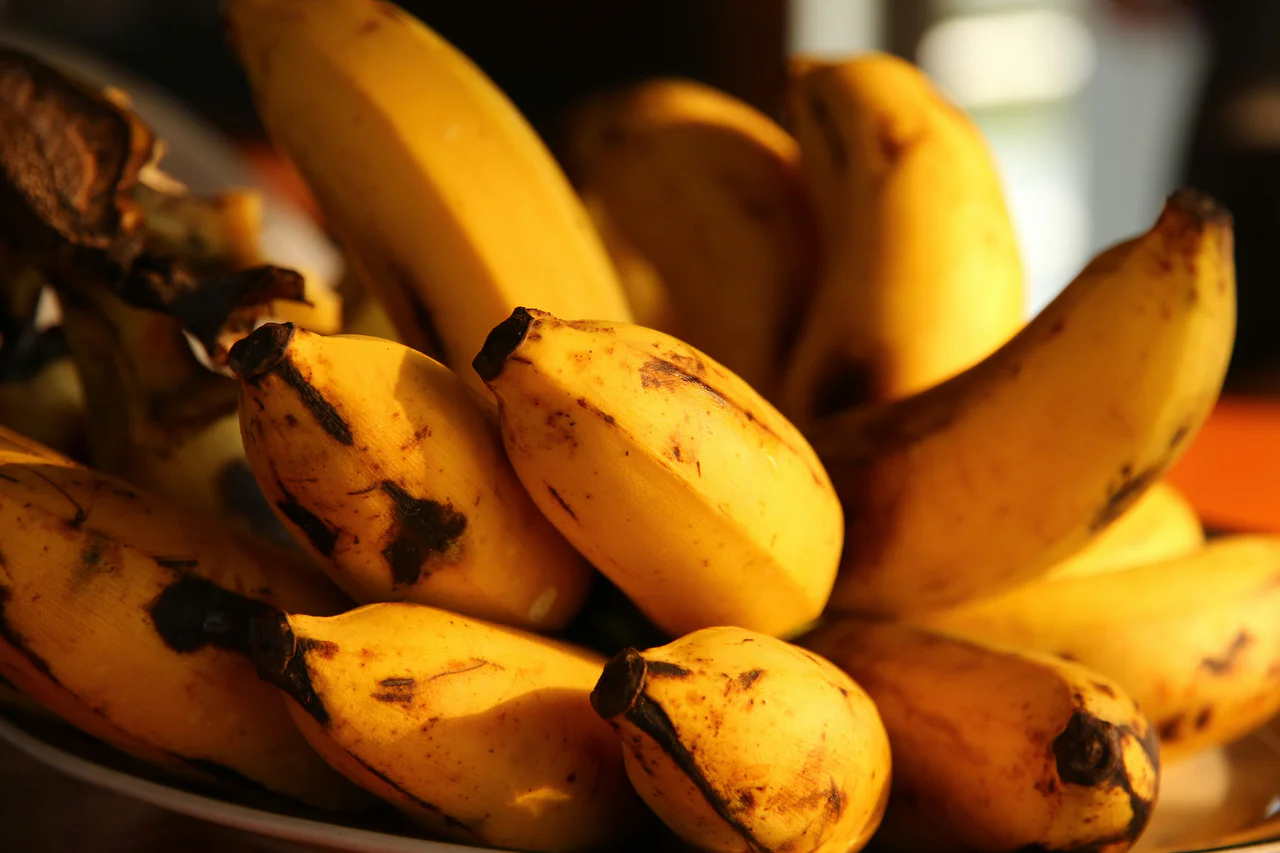
Wait, is that banana really radioactive? Yes: a medium one has about 13 potassium-40 atoms decaying every second, a few hundred times fewer than the roughly 3,900 decaying inside an average adult man, based on Pacific Northwest National Laboratory measurements of Hanford workers.
Radioactive, yes. A health issue, no.
The first half of the headline holds and the second half doesn’t. The US Environmental Protection Agency puts the dose from one banana at 0.1 microsieverts (µSv), about 1/100 of a typical American day of natural radiation, and says foods like it pose no radiation risk.
Fine, but why would fruit be radioactive?
Potassium is an essential nutrient, and about 0.0117% of natural potassium atoms are potassium-40, an isotope with a half-life of 1.248 billion years, according to PNNL’s report. Roughly 89% of its decays release a beta particle and about 11% a gamma ray. The same report puts the activity of natural potassium at 31.72 becquerels (decays per second) per gram.
The NIH Office of Dietary Supplements lists 422 milligrams of potassium in a medium banana, so the arithmetic is 0.422 g × 31.72 Bq/g ≈ 13.4 Bq. A Berlin radiation-protection lab, LPS, gets 12.5 Bq for a 120-gram banana with 430 milligrams of potassium. Bananas also vary. The USDA’s analysis of 45 samples found 308 to 426 milligrams of potassium per 100 grams, which scales to roughly 11.5 to 16 Bq for a medium banana.
How big is 0.1 microsieverts?
The EPA’s yardstick is about 100 bananas to match one day of natural radiation in the United States, which works out to 10 µSv a day. The number depends on where you live. LPS uses 5.8 µSv a day for Germany, so the same day is worth about 72 bananas at its 0.080 µSv per banana. The 0.1 µSv headline is rounded, too: LPS applies an ingestion coefficient of 6.2 nanosieverts per becquerel, and 6.2 × 13.4 gives about 0.083 µSv.
Does it add up if I eat one every day?
Not the way a chest scan’s dose does. Potassium is under homeostatic regulation, according to PNNL, and the NIH says excretion rises rapidly in healthy people after they eat it. The Finnish radiation regulator STUK reports that an adult carries 3,000 to 6,000 Bq of potassium-40 at any moment. One banana adds about 0.3% to PNNL’s average for men (3,933 Bq) and about 0.5% to its average for women (2,539 Bq), and the surplus is excreted.
So is the dose zero, or 0.1?
Neither holds up. Health physicist Geoff Meggitt told journalist Maggie Koerth-Baker, in a 2010 Boing Boing piece, that eating a banana doesn’t raise your potassium-40 level, so the net dose is zero.
The EPA’s cancer-risk report, Federal Guidance Report 13, supplies the other half. It says its ingestion coefficient for potassium-40 rests on a 30-day biological half-time that suits typical intakes, and that the coefficient would not suit potassium-40 arriving with an elevated potassium intake, because a nearly equal mass of potassium, and so of potassium-40, would be excreted over a short period. A banana on top of a normal diet is at least close to the situation it describes.
You can bracket the answer with two sourced figures. PNNL’s measurements give each body’s baseline: men carry 3,933 Bq and receive 0.149 mSv a year from it, women 2,539 Bq and 0.123 mSv. Scaling to the banana’s 13.4 Bq gives the extra dose for every day its potassium-40 sits on top of that baseline.
| Step | Men | Women |
|---|---|---|
| Potassium-40 in the body (PNNL) | 3,933 Bq | 2,539 Bq |
| Annual dose from it (PNNL) | 0.149 mSv | 0.123 mSv |
| Dose per day | 0.408 µSv | 0.337 µSv |
| Banana as a share of body activity | 0.34% | 0.53% |
| Extra dose per day the banana’s K-40 stays | 0.0014 µSv | 0.0018 µSv |
| If all of it stayed 30 days | 0.042 µSv | 0.053 µSv |
| Days needed to reach 0.1 µSv | 72 | 56 |
These are calculations from the two sources, not published estimates, and they assume the banana’s potassium-40 spreads through the body like the baseline does. The dose isn’t zero while the banana’s potassium is in you, and the 0.1 µSv headline would need that extra potassium to linger for about two months. If the surplus clears within a day, the dose is closer to 0.002 µSv. The weak point is clearance time: the NIH says excretion rises rapidly but gives no figure in hours, so the one-day row is a floor rather than a measurement.
Could a Geiger counter catch it?
A Geiger counter is unlikely to show it, and a Harvard lecture demonstration hints at why. Harvard’s Natural Sciences Lecture Demonstrations uses a scintillation detector inside a thick iron shield and about 17 minutes of counting to pull a clean potassium-40 peak out of a seated adult, whose body holds roughly 300 times the activity of one banana. The same page says a 311-gram shaker of potassium-based salt substitute gives a convincing peak within minutes, which is far more potassium than a banana carries. That page tests bodies and salt, not bananas, so treat the banana case as an inference. Stories of banana cargo tripping border radiation monitors circulate widely, but no agency documentation turned up for them.
What should I ask for instead of bananas?
Radiologists at the University Hospital Freiburg compared the two framings in a 2023 paper in Die Radiologie, calling the banana equivalent dose a pseudoscientific unit and recommending that patient conversations use the effective dose of the exam instead. If someone explains a scan or a leak to you in bananas, ask for the figure in millisieverts.
Quick questions
Sources
US Environmental Protection Agency. Natural Radioactivity in Food (opens in a new tab), epa.gov, .
Accessed .
States one banana delivers 0.1 microsieverts, about 100 bananas equal a US day of natural radiation, foods like it pose no radiation risk, and Brazil nuts also contain radium.
D. J. Strom, T. P. Lynch, D. R. Weier. Radiation Doses to Hanford Workers from Natural Potassium-40 (PNNL-18240) (opens in a new tab), pnnl.gov, .
Accessed .
Supplies the 0.0117% abundance, 31.72 Bq per gram, decay modes, homeostatic regulation, and the body activity and annual dose figures for men and women.
US EPA (Eckerman, Leggett, Nelson, Puskin, Richardson). Cancer Risk Coefficients for Environmental Exposure to Radionuclides, Federal Guidance Report No. 13 (opens in a new tab), epa.gov, .
Accessed .
States the potassium-40 ingestion coefficient assumes a 30-day biological half-time and is not appropriate for ingestion with an elevated intake of natural potassium.
NIH Office of Dietary Supplements. Potassium: Fact Sheet for Health Professionals (opens in a new tab), ods.od.nih.gov, .
Accessed .
Lists 422 mg of potassium in a medium banana, rapid excretion in healthy people, and the kidney disease and medication caveats.
Säteilyturvakeskus (STUK). Radioactivity in human body (opens in a new tab), stuk.fi.
Accessed .
States an adult usually contains 3,000 to 6,000 becquerels of potassium-40.
Landesanstalt für Personendosimetrie und Strahlenschutzausbildung (LPS). Radioaktives Obst? Die Wahrheit über die Banane (opens in a new tab), lps-berlin.de.
Accessed .
Gives 12.5 Bq and 0.080 microsieverts for a 120 g banana, the 6.2 nSv per Bq coefficient, 5.8 microsieverts per day for Germany, and the dental X-ray and flight comparisons.
US Department of Agriculture, Agricultural Research Service. Bananas, raw (SR Legacy, FDC 173944) (opens in a new tab), FoodData Central (copy hosted on files.givewell.org).
Accessed .
Shows 358 mg of potassium per 100 g, with a range of 308 to 426 mg across 45 analyses.
Maggie Koerth-Baker. Bananas are radioactive, but they aren't a good way to explain radiation exposure (opens in a new tab), boingboing.net, .
Accessed .
Reports health physicist Geoff Meggitt's argument that the net dose of a banana is zero because the body holds potassium under homeostatic control.
Harvard Natural Sciences Lecture Demonstrations. Radioactive Human Body (opens in a new tab), sciencedemonstrations.fas.harvard.edu.
Accessed .
Describes the shielded scintillation detector, roughly 17-minute count and potassium chloride salt substitute test used to detect potassium-40.
T. Stein, T. Schuermann, F. Bamberg, K. Mueller-Peltzer. Strahlenexposition erklären (Explaining radiation dose exposure) (opens in a new tab), Die Radiologie, .
Accessed .
Abstract calls the banana equivalent dose a pseudoscientific unit and recommends effective dose for patient consultations.