Why did the steering suddenly go light on that wet stretch of highway? The tires were still on the car. The road was still there. But for a moment, the connection between them was gone. That moment is hydroplaning, and it starts with a wedge of water you cannot see.
Hydroplaning happens when water cannot escape the tire’s contact patch fast enough, and a thin film lifts the tire off the road. Tread depth is the main variable you control.
The water wedge builds in front of the tire
A tire rolling on a wet road pushes water ahead of it. That water has to go somewhere. At low speed, there is enough time for the tire to squeeze the water out from under the contact patch and for the tread grooves to channel it away. The rubber stays in contact with the pavement. Traction is maintained.
As speed increases, the time available for water removal shrinks. The Michigan Department of State Highways and Transportation describes the sequence in a 1972 research report. As the tire rolls faster, less time is available for squeezing water from beneath the tire. When the time for water removal becomes too short, not all the water is removed. The tire begins to lose contact with the pavement. A wedge of water penetrates the tire-pavement interface. The hydrodynamic pressure under the tire increases. If speed increases further, the tire gradually but completely loses contact and is entirely supported on the water wedge.
This is dynamic hydroplaning. It is distinct from viscous hydroplaning, which occurs on smooth, polished pavement with a very thin film of water, sometimes just a heavy dew. Dynamic hydroplaning requires a deeper film, but it is the type most drivers encounter at highway speeds.
The tread grooves are the only escape route
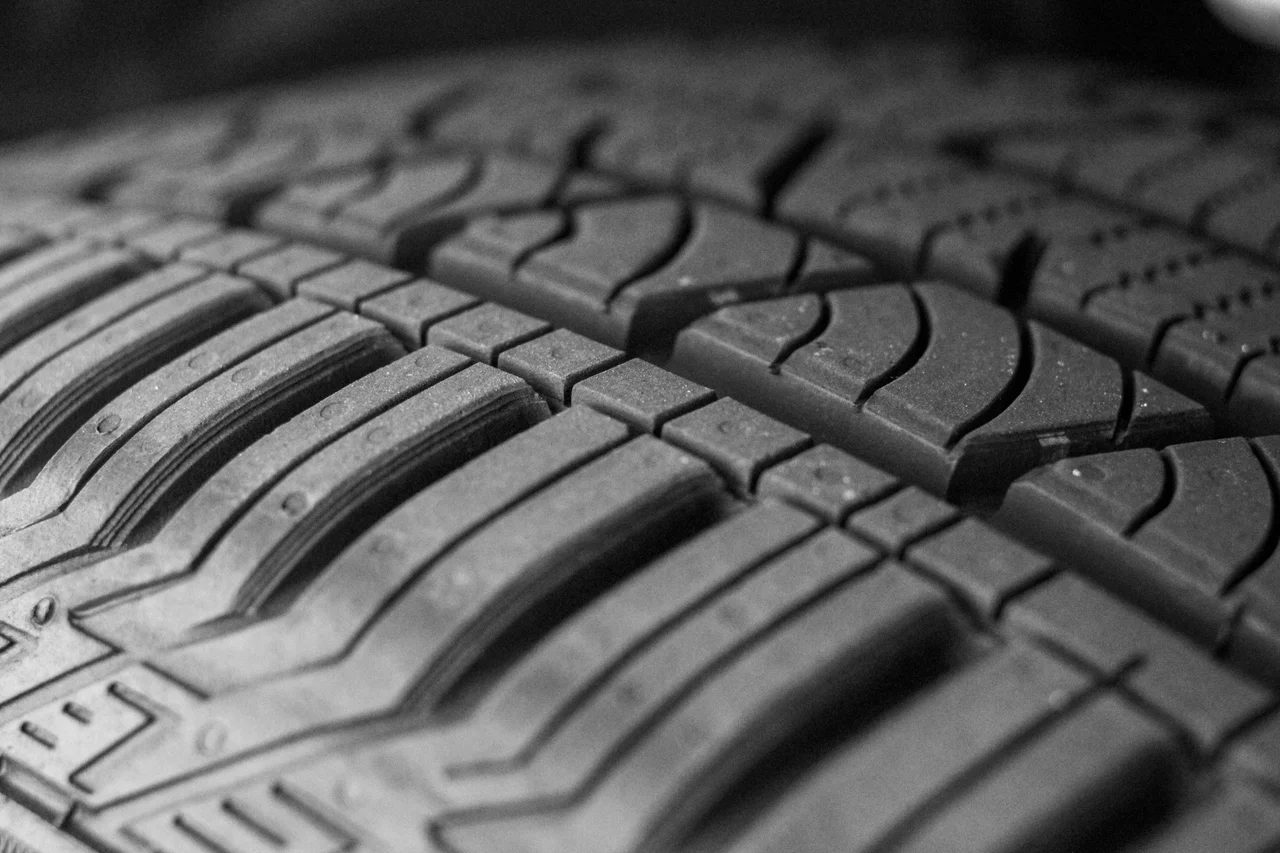
The tread pattern on a tire is not decorative. The grooves, also called voids, are channels for water. The percentage of the tread surface that is groove is called the void ratio. More void means more space for water to evacuate from the contact patch.
A 2013 SAE International technical paper by Debra Seguin and colleagues tested passenger car tires under minimally wet conditions. The paper reports that tire tread depths of less than about 3.0 mm (4/32 inches) develop significantly less cornering friction on wet surfaces at highway speeds than tires with greater tread depth, and can approach hydroplaning at those speeds even when the water film is thin.
The 3.0 mm figure is not the legal minimum. It is a performance threshold. Below it, the grooves cannot hold and channel water fast enough to maintain the friction the driver needs for steering and braking.
A 2024 review in the journal Results in Engineering confirmed the pattern. The review found that hydroplaning risk can be minimized by deeper and more intricate tire treads, higher inflation pressure, reduced water film thickness and density, and enhanced surface drainage. The tread is the part of that list the driver controls directly.
When the grooves fill faster than they drain
The transition from grip to hydroplaning is not instantaneous. It depends on how fast water enters the contact patch compared with how fast the grooves can remove it. When the inflow exceeds the outflow, the water wedge grows. The hydrodynamic pressure rises. The tire lifts.
The speed at which full hydroplaning occurs can be predicted with an equation developed by NASA researchers in the 1960s. Horne and Dreher derived a simplified formula that has been validated in joint FHWA-NASA tests. In metric units, the minimum hydroplaning speed is V = 6.35 times the square root of the tire inflation pressure in kilopascals. In US customary units, it is V = 10.35 times the square root of pressure in psi. The Michigan report gives the equation and the validation.
A tire inflated to 220 kPa (32 psi) has a predicted hydroplaning speed of about 94 km/h (58 mph). A tire at 180 kPa (26 psi) drops to about 85 km/h (53 mph). Lower pressure means a lower hydroplaning speed. This is one reason underinflated tires are dangerous in the rain.
The equation applies when the water depth exceeds the tread depth. That is the flooded-pavement condition. Partial hydroplaning can begin at lower speeds, on thinner films, when tread depth is reduced. The Horne equation predicts the full-loss speed, not the onset of partial loss.
What the 3 mm threshold actually means
Tires are legally worn out in most US states at 2/32 inch (1.6 mm) of remaining tread. But the SAE research shows that the safety margin is already shrinking well before that. The National Highway Traffic Safety Administration has acknowledged that wet traction drops sharply once tread reaches 4/32 inch. A 1975 NHTSA interpretation on hydroplaning states that the two hydroplaning phenomena can be controlled by the proper selection of pavement texture and tread depth of tires. The agency notes that tire manufacturers provide water escape passages and tread depth to cope with the problem, but the tire is only a subsystem within the tire-pavement system.
The practical reading is that 4/32 inch (3.2 mm) is the point where wet-weather performance begins to fall off sharply. A tire at 3 mm may still pass a state inspection at 1.6 mm, but it will not have the water evacuation capacity it had when new.
What you can feel before full hydroplaning
Full hydroplaning is the dramatic version. The tire is entirely supported on water and the driver has no steering or braking control. But partial hydroplaning happens first, and it gives warning signs.
The Michigan report notes that as a highway vehicle begins to hydroplane, either partial or complete control may be lost. Because the front wheels provide some wiping for the rear wheels, steering control may be lost before drive traction. The driver may feel the steering go light before the car loses forward grip.
Other signs include a sudden increase in engine speed if the drive wheels spin, a feeling of floating or vagueness through the steering wheel, and a reluctance to respond to steering inputs. If you feel these, you are already in the transition zone. Easing off the accelerator and keeping the steering steady is the response. Braking hard or turning sharply can make it worse.
What to look for next time
Check your tread depth with a gauge, not a coin. A tread depth gauge costs a few dollars and gives you a number. The legal minimum is 1.6 mm (2/32 inch). The safety recommendation from the SAE research and from tire safety organizations is to replace at 3 mm (4/32 inch) for wet-weather driving.
Check tire pressure monthly. The Horne equation shows that hydroplaning speed is proportional to the square root of inflation pressure. A tire at 180 kPa hydroplanes at a lower speed than the same tire at 220 kPa. The recommended pressure is on the door jamb sticker, not the tire sidewall.
And when the road is wet, slow down. The equation gives you the speed where full hydroplaning occurs under flooded conditions. The transition to partial hydroplaning starts earlier. If you see standing water, the safest speed is the one that keeps your tires in contact with the pavement.
Still wondering
Sources
Seguin, D. E. et al.. Friction, Tread Depth and Water; Laboratory Investigations of Passenger Car Tire Cornering Performance under Minimally-Wet Conditions (opens in a new tab), SAE International, .
Supports the finding that tire tread depths of less than about 3.0 mm (4/32 inches) develop significantly less cornering friction on wet surfaces at highway speeds and can approach hydroplaning with minimal water film thickness.
Michigan Department of State Highways and Transportation. Hydroplaning on Highways (opens in a new tab), mdotjboss.state.mi.us, .
Supports the description of dynamic hydroplaning, the water wedge mechanism, the Horne-Dreher equation V = 10.35√p (mph, psi), the distinction between viscous and dynamic hydroplaning, and the note that steering control may be lost before drive traction.
Transportation Research Board. The development of this equation assumes an elliptical tire footprint shape (opens in a new tab), onlinepubs.trb.org, .
Supports the Horne equation in metric units V_H = 6.35√p (km/h, kPa), the applicability to flooded pavements where water depth exceeds tire tread depth, and the modification for footprint aspect ratio.
National Highway Traffic Safety Administration. nht75-6.32 (opens in a new tab), nhtsa.gov, .
Supports the recognition that hydroplaning can be controlled by proper selection of pavement texture and tread depth, the two types of hydroplaning, and the statement that the tire is only a subsystem within the tire-pavement system.
Leland, T. J. W.. Some Parameters Affecting the Performance of Pneumatic Tires on Wet Pavement (opens in a new tab), NASA Langley Research Center, .
Supports the role of tire tread design in delaying the build-up of hydrodynamic pressure in the tire footprint area and improving braking and cornering traction on wet pavement.
Results in Engineering. A review of numerical and experimental studies on hydroplaning of vehicles in motion on road surfaces (opens in a new tab), ScienceDirect, .
Supports the finding that hydroplaning risk can be minimized by deeper and more intricate tire treads, higher inflation pressure, reduced water film thickness and density, and enhanced surface drainage.