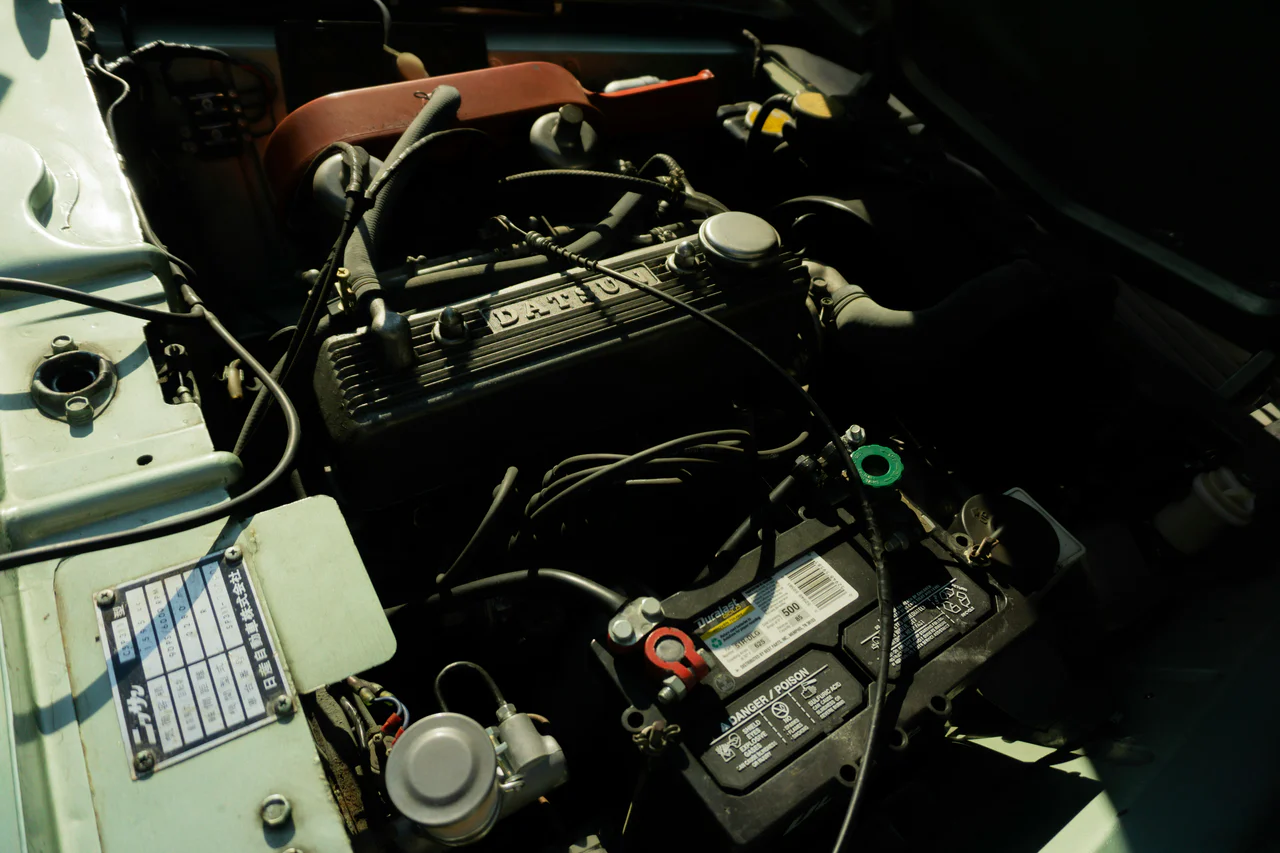
You park after a short drive, switch off the engine, and still hear a low fan whirring under the bonnet. The air is cool, so what is the car trying to cool? The sound itself is ordinary, since the Volvo owner support page for the XC60 says it is normal for the engine’s cooling fan to keep running a while after the car is turned off. What matters is what that fan is cooling.
Cool air does not switch the fan off
The claim holds. Ford’s owner’s manual for its Transit van says the engine cooling fan may run for several minutes after switch-off in all ambient temperatures, and Ford and Mitsubishi tie it to heat in the engine bay and exhaust.
What happens when the engine stops
When the engine stops, the parts that move heat around stop too. An SAE International technical paper from 2012 reports that after a long drive, the coolant temperature inside an engine’s cooling jacket rises within a very short time after key-off, which the authors say can be due to the coolant pump and fan shutting off.
A 2024 study in Scientific Reports by researchers in China tested an SUV after low-speed hill climbing in 38°C air. For the first 30 seconds after key-off the fan was still running, and the temperatures of heat-sensitive parts stayed stable. Once the fan stopped, heat moved by natural convection, which is less efficient, and temperatures rose sharply before easing back toward the surrounding air. The exhaust system, still hot, kept passing heat to those parts. That test used 38°C air and a hard climb, so it shows the mechanism but not how often a fan runs on in cooler conditions.
A timer someone had to choose
How long the fan keeps running is a design choice. The same paper offers its results as a reference for designing the fan’s run time after key-off. Volvo describes its cooling system as an advanced temperature regulation system, and Ford says its fan can run for several minutes. Neither gives one fixed time for every car. Mitsubishi’s FAQ for its Delica D:5 diesel, written for the Japanese market, says only that the fan stops by itself after running for a set time.
Why short trips in cool air are not exempt
Ford’s manual names short journeys and low coolant temperature as examples of when the fan can run on, and it points readers to the diesel particulate filter section. That filter traps soot, and the system cleans it by raising the exhaust temperature in a process called regeneration. For the Transit, Ford says regeneration comes every 160 to 500 km, depending on driving style, outside air temperature and altitude, and each one lasts 10 to 20 minutes. Ford lists short-distance driving, prolonged idling and frequent engine on and off use among the cases where it recommends helping regeneration along. The manual adds that the exhaust radiates considerable heat during and after regeneration, including after the engine is switched off.
Mitsubishi describes the same chain for its diesel. If the engine is stopped during or just after the filter burns off soot, exhaust parts rise in temperature and the fan keeps running for a while. Together with the Scientific Reports finding that heat-sensitive parts keep receiving heat from a hot exhaust, this means a short trip that ends in a regeneration cycle can leave a hot exhaust and a running fan on a cool day. These two manufacturers describe diesel models with this filter.
What the fan is moving air past
The Scientific Reports team tracked parts such as the battery, an oxygen sensor wiring harness and an exhaust hanger. Their concern was heat-sensitive parts that stay above their temperature limits after the fan stops, which can lead to thermal damage or fatigue. A model’s own owner’s manual is the place to look for its behaviour: Volvo documents the run-on under its engine cooling system page, and Ford under maintenance, engine cooling fan.
So the whirring under the bonnet after a short drive in cool air is likely the sound of air moving past a hot exhaust and the wiring and components beside it, which Volvo’s manual calls normal.
Still wondering
Sources
Volvo Cars (Sweden). Engine cooling system (opens in a new tab), volvocars.com, .
Supports the statement that it is normal for the engine cooling fan to keep running after the car is turned off and the advice on idling after demanding driving.
Ford Motor Company (United States). Maintenance: Engine Cooling Fan (opens in a new tab), fordservicecontent.com.
Supports the fan running for several minutes after switch-off in all ambient temperatures and independent of coolant temperature, with short journeys as an example, and the hands and clothing warning.
Ford Motor Company (United States). Engine Emission Control: Diesel Particulate Filter (opens in a new tab), fordservicecontent.com.
Supports regeneration raising exhaust temperature, its frequency of 160 to 500 km and duration of 10 to 20 minutes, the short-distance driving cases and the exhaust heat after switch-off.
Mitsubishi Motors (Japan). ディーゼル車はエンジン停止後も冷却ファンが作動することはありますか?[デリカD:5(LDA-CV1W/3DA-CV1W)] (Can the cooling fan keep running after the engine stops on a diesel vehicle? [Delica D:5]) (opens in a new tab), faq.mitsubishi-motors.co.jp, .
Supports the fan running while the engine compartment is hot, the fan running after the engine is stopped during or just after filter soot burn-off, and the fan stopping automatically after a set time.
Gao, Z. et al.. Numerical investigation of thermal soak within engine bay using lattice Boltzmann method (opens in a new tab), pmc.ncbi.nlm.nih.gov, .
Supports the key-off heat build-up, the stable temperatures for 30 seconds while the fan ran, the temperature rise after it stopped, the hot exhaust, the tracked parts and the fan run time design reference.
Ali, M. et al.. Determination of Time Variant 1D-3D Temperature and Heat Transfer Distribution Inside the Cooling Jacket of a SI Engine Cooling System after Key-Off (opens in a new tab), saemobilus.sae.org, .
Supports the coolant temperature rising soon after key-off following a long drive, linked to the pump and fan shutting off, in a 1.6 litre spark-ignition engine.