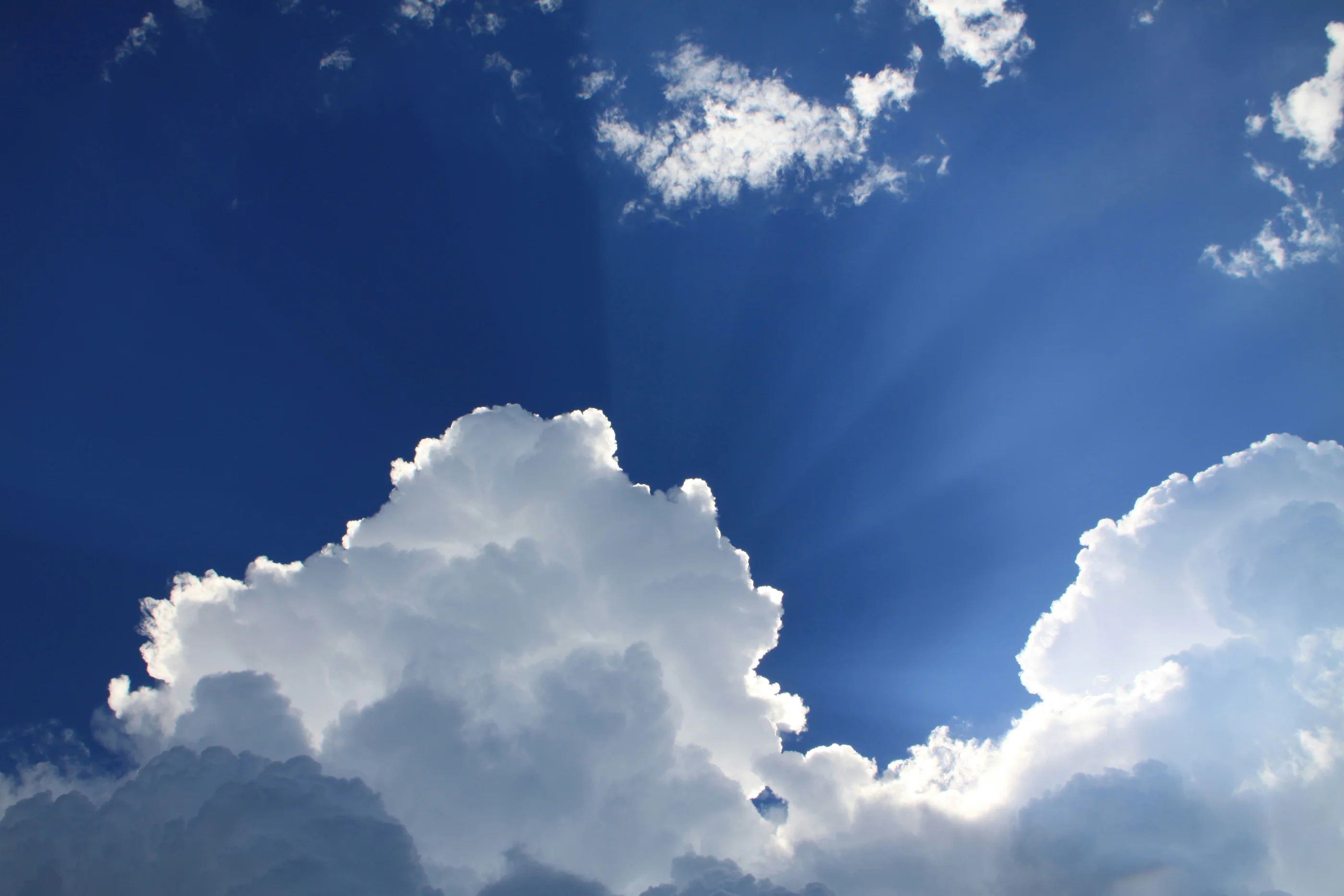
Step outside on a clear afternoon and look straight up. Nothing up there is actually blue. Sunlight left the sun as a mix of every wavelength, roughly white, and none of it changed color on the way down. What you’re looking at is the result of billions of tiny collisions, and the reason it looks blue to you specifically is stranger than most explanations let on.
The quick answer
Air molecules scatter short wavelengths of light, like blue, far more than long wavelengths, like red. Blue light bounces around the atmosphere in every direction until it seems to come from the whole sky at once, not just from the sun’s direction. Violet actually scatters even harder than blue, but the sun sends out less of it and your eyes are worse at catching it, so blue wins the vote in your vision, not violet.
Why blue loses the fight to travel in a straight line
Sunlight hits nitrogen and oxygen molecules, which are far smaller than the wavelength of visible light itself. Physicist Lord Rayleigh worked out in the 1870s that scattering off particles this small depends on wavelength raised to the fourth power, inverted. Cut a wavelength in half and you scatter it sixteen times harder.
Run the numbers on visible light and it gets specific fast. Blue light sits around 450 nanometers, red around 700. Do that ratio and raise it to the fourth power and blue scatters close to six times more than red does. That’s not a subtle tilt. It’s the entire reason the sky has a color at all instead of looking like a slightly dimmer sun surrounded by black.
Red, orange, and yellow light barely scatters. It travels through the atmosphere in something close to a straight line, which is exactly why the sun itself looks yellow-white rather than blue: you’re seeing the light that made it through untouched, not the light that got bounced.
The color that should technically be up there instead
Here’s the part most explanations skip. Violet has an even shorter wavelength than blue, sitting around 400 nanometers, which means it scatters even more aggressively than blue does under that same fourth-power rule. If pure physics decided the color of the sky, you’d be looking up at violet, not blue.
Two things stop that from happening. The sun’s own spectrum peaks in the blue-green range rather than violet, so there’s simply less violet light arriving to scatter in the first place. And your eyes aren’t built to catch it well even if it were there: the cone cells sensitive to short wavelengths make up a small fraction of the receptors in your retina, and their sensitivity trails off before it reaches true violet. Blue is what your visual system actually resolves as the dominant signal, so blue is what you get.
It has nothing to do with the ocean
A surprising number of people grow up thinking the sky is blue because it’s reflecting the ocean, or that the two colors are somehow linked. It’s backward. The ocean looks blue for its own separate reason: water absorbs red wavelengths more than blue as light travels through it, and any blue you see bouncing off open water is mostly the sky’s own color reflecting back at you anyway. Landlocked places with clear air get exactly the same blue sky as coastal ones. Take away the atmosphere and the ocean would still be there. Take away the ocean and the sky would look identical.
Why Mars looks nothing like this at noon
If Rayleigh scattering were the whole story of planetary skies, Mars would look blue too, since its atmosphere scatters short wavelengths for the same reason. But Mars’s daytime sky reads as a dusty butterscotch, because its air carries fine dust particles that are much larger relative to light’s wavelength than gas molecules are. That shifts the physics from Rayleigh scattering into Mie scattering, which doesn’t favor short wavelengths nearly as strongly and instead scatters light more evenly, tinted by the color of the dust itself, mostly iron oxide.
Oddly, Mars flips the arrangement at sunset. Fine dust suspended near the horizon scatters blue light forward toward an observer more efficiently than it scatters other colors, so the sky right around the setting sun turns a cool blue while the rest of the sky stays warm-toned. NASA’s Pathfinder and Curiosity rovers have both photographed it. Earth and Mars run the same basic scattering physics through two different atmospheres and land on close to opposite results.
Where this explanation runs out
It doesn’t explain overcast days. Water droplets in clouds are much larger than gas molecules, big enough to scatter every wavelength of visible light almost equally. That’s why clouds and hazy, humid skies look white or gray instead of blue: you’re getting all the colors scattered back at once instead of blue winning out.
It doesn’t account for pollution and particulates. Add enough dust, smoke, or aerosol pollution to the air and you introduce the same kind of Mie scattering that colors Mars’s sky, which is part of why heavily polluted or smoky skies shift toward white, brown, or a dull haze instead of a clean blue, even on an otherwise clear day.
If you actually want to see it at its best
If you want the deepest, most saturated blue, get to altitude and dry air. Thinner atmosphere means less total scattering between you and space, and less water vapor means less of that whitening Mie scattering muddying the color. That’s why the sky over a high desert or a mountain summit reads as a noticeably darker blue than the sky over a humid coastline at sea level.
If you’re chasing a good sunset instead, you want the opposite conditions on the horizon. A little extra dust, humidity, or aerosol content low in the atmosphere at sunset scatters and reddens the light even more dramatically, which is part of why sunsets after a dry, dusty day or downwind of wildfire smoke tend to run deeper orange and red than a perfectly clean sky produces.
The sky isn’t blue because it’s reflecting anything or because blue is somehow the atmosphere’s natural color. It’s blue because of a wavelength-dependent scattering fight that blue wins by a wide margin over red, loses by a wide margin to violet, and only ends up on top because the sun’s own spectrum and the limits of your eyes break that final tie in blue’s favor.