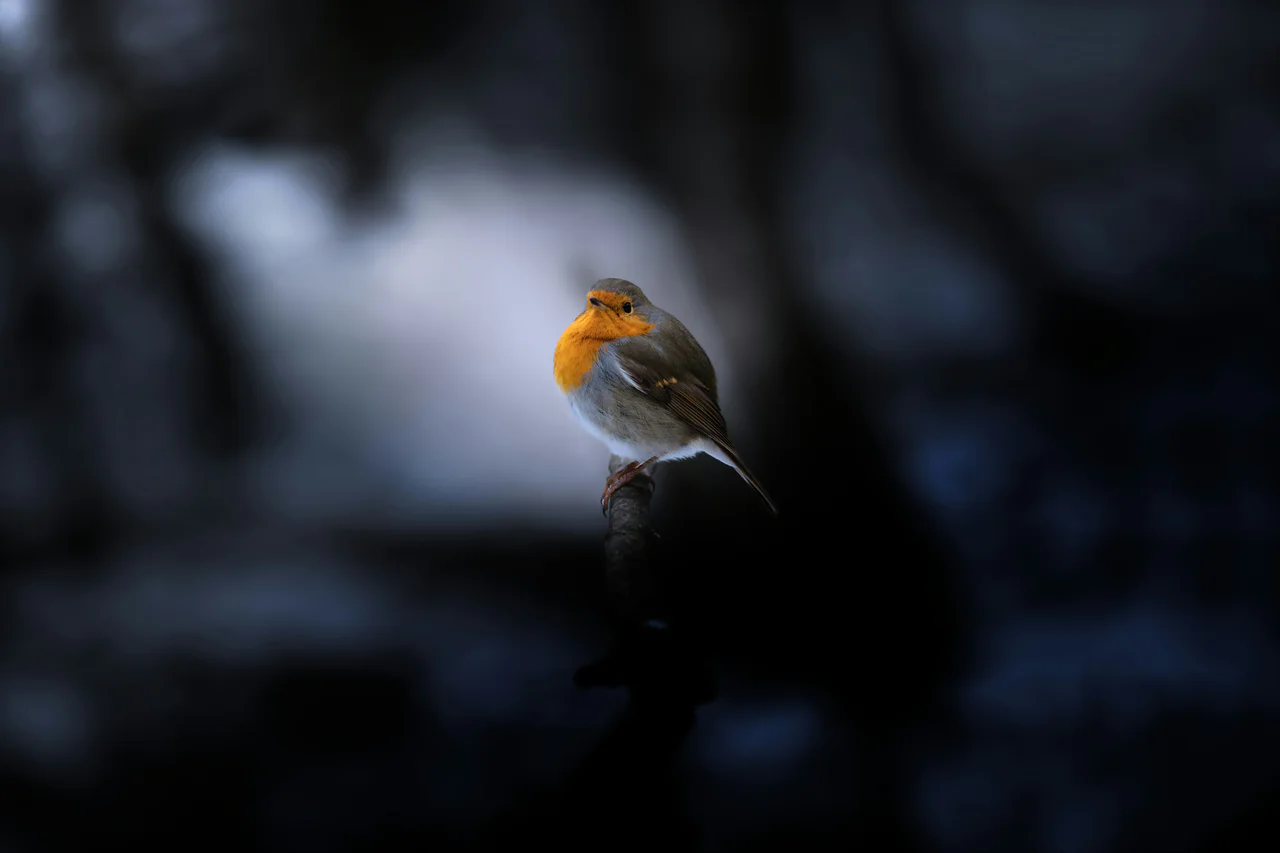
A European robin, sealed in a cardboard box with no light, no landmarks, and no smell of home, will still hop toward magnetic south when the season says it’s time to migrate. Cut the light entirely and the bird goes lost. That single detail is the whole mystery in miniature: this isn’t a chemical trace or an inherited flight path. The robin appears to be reading the Earth’s magnetic field with its eyes, using a chemical reaction that physicists say shouldn’t work outside a supercooled lab.
The quick answer
Migratory songbirds most likely sense magnetic north through a light-triggered chemical reaction in a retinal protein called cryptochrome 4a (Cry4a). When blue light hits the protein, an electron hops step by step along a chain of amino acids, creating a short-lived pair of radicals whose spins are quantum mechanically linked. Earth’s magnetic field, though 100 times weaker than a fridge magnet, is strong enough to nudge how that spin pair behaves, and the outcome of that nudge appears to shape what the bird sees.
Why blue light and not just “light”
Cryptochromes are flavoproteins, related to the light receptors that reset your own circadian clock. In Cry4a, absorbing blue light kicks an electron out of the protein’s flavin cofactor (FAD) and sends it hopping along four tryptophan residues in sequence, labeled A through D. Each hop leaves behind a radical pair: two unpaired electrons, one on the flavin and one on a tryptophan, whose spins started out correlated. In purified Cry4a, the third of these flavin-tryptophan radical pairs is more magnetically sensitive than the fourth, which fits with the radicals sitting closer together at that stage of the chain. That difference matters because it splits the protein’s job in two: one radical pair state seems built for sensing the field, the next for actually signaling that information onward.
The information-gain part: which protein, and why this one
Researchers have spent decades narrowing down which of the six cryptochromes birds carry actually does this work. In 2021, a Nature study showed that CRY4 purified from the night-migratory European robin is magnetically sensitive in a test tube, and notably more so than the same protein taken from non-migratory chickens and pigeons. That was the first time anyone had shown magnetic sensitivity in a cryptochrome from an animal that actually migrates, rather than inferring it from a proxy species.
The evidence has kept narrowing since. A phylogenetic analysis of the tryptophan tetrad found that these specific residues are highly conserved across the entire avian clade, and separately, positive selection has been detected at two nearby residues in the Cry4a sequence of migratory songbirds specifically, as if evolution kept fine-tuning this one protein and no other. That makes a 2025 result in the Journal of the Royal Society Interface worth putting right next to it: the same research group has now reported that Cry4b, a close cousin of Cry4a, is probably irrelevant to radical-pair-based magnetoreception in the European robin. Put those two findings together and you get something no single paper says outright: evolution wasn’t just tuning “a cryptochrome” for this job, it was tuning this one specific molecule, while its nearest relative sat this one out entirely.
The part that shouldn’t work
Here’s the catch that keeps physicists in this field employed. Quantum spin coherence, the property that makes the radical pair sensitive to a magnetic field at all, is notoriously fragile. It usually collapses in an instant when jostled by the heat and water molecules inside a living cell. A bird’s retina is warm, wet, and chaotic, exactly the environment quantum coherence is supposed to hate. For years, the standard assumption was that only radical pairs with widely separated, weakly interacting electrons could stay magnetically sensitive, since closely bound pairs were thought to have their spin dynamics arrested. A late-2024 Nature Communications paper complicates that picture directly, showing that tightly bound radical pairs can retain magnetic sensitivity too, through a quantum Zeno effect that essentially freezes the spin state just long enough to matter. The field hasn’t closed this gap so much as found a second, stranger way to cross it.
The myth worth correcting
The popular version of this story usually involves birds having tiny bits of metal in their beaks that swing like a compass needle. That idea isn’t invented, it’s a real competing hypothesis: iron-rich, magnetite-based receptors have long been proposed in the trigeminal nerve near a bird’s upper beak. But it’s increasingly treated as a separate system from the one described here, possibly contributing to a magnetic “map” sense (roughly, “where am I”) rather than the compass “which way is north” that the retinal cryptochrome pathway is built to answer. They’re not competing explanations for the same trick. They may be two different senses running at once.
Two systems, two jobs
| Retinal radical-pair compass | Beak-region magnetite system | |
|---|---|---|
| Location | Cryptochrome in photoreceptor cells, eyes | Proposed trigeminal receptors, upper beak |
| Needs light | Yes, specifically blue wavelengths | No |
| Best evidence for | Direction (compass) | Position or intensity (map), still debated |
Where the evidence still falls short
In vitro isn’t in vivo. Nearly everything above comes from purified protein in a cuvette responding to a magnetic field in a lab. Showing that a bird’s actual visual system reads out that chemical signal, and that the signal changes real flight behavior, is a much harder experiment, and it’s still mostly indirect.
The field hasn’t agreed on one molecule for good. Ruling out Cry4b in 2025 narrows things, but it doesn’t finish the case for Cry4a either. Six avian cryptochromes exist, and the process of elimination is ongoing rather than settled.
If you’re the type who wants the practical version
If you’re a birdwatcher: the behavior evidence for this compass, including that darkness disrupts it and specific light wavelengths restore it, is well replicated across multiple songbird species, so it’s on solid experimental ground even where the deep mechanism isn’t. If you’re physics-curious: the open question worth following is exactly how a warm, noisy cell preserves quantum coherence at all, since that answer will likely reach well past ornithology. If you just want the headline: a European robin’s eye may be running a quantum mechanics experiment every time it looks toward the horizon at night, and the experiment works.
That cardboard box result at the top isn’t a party trick. It’s a bird using quantum chemistry to find Africa in the dark.