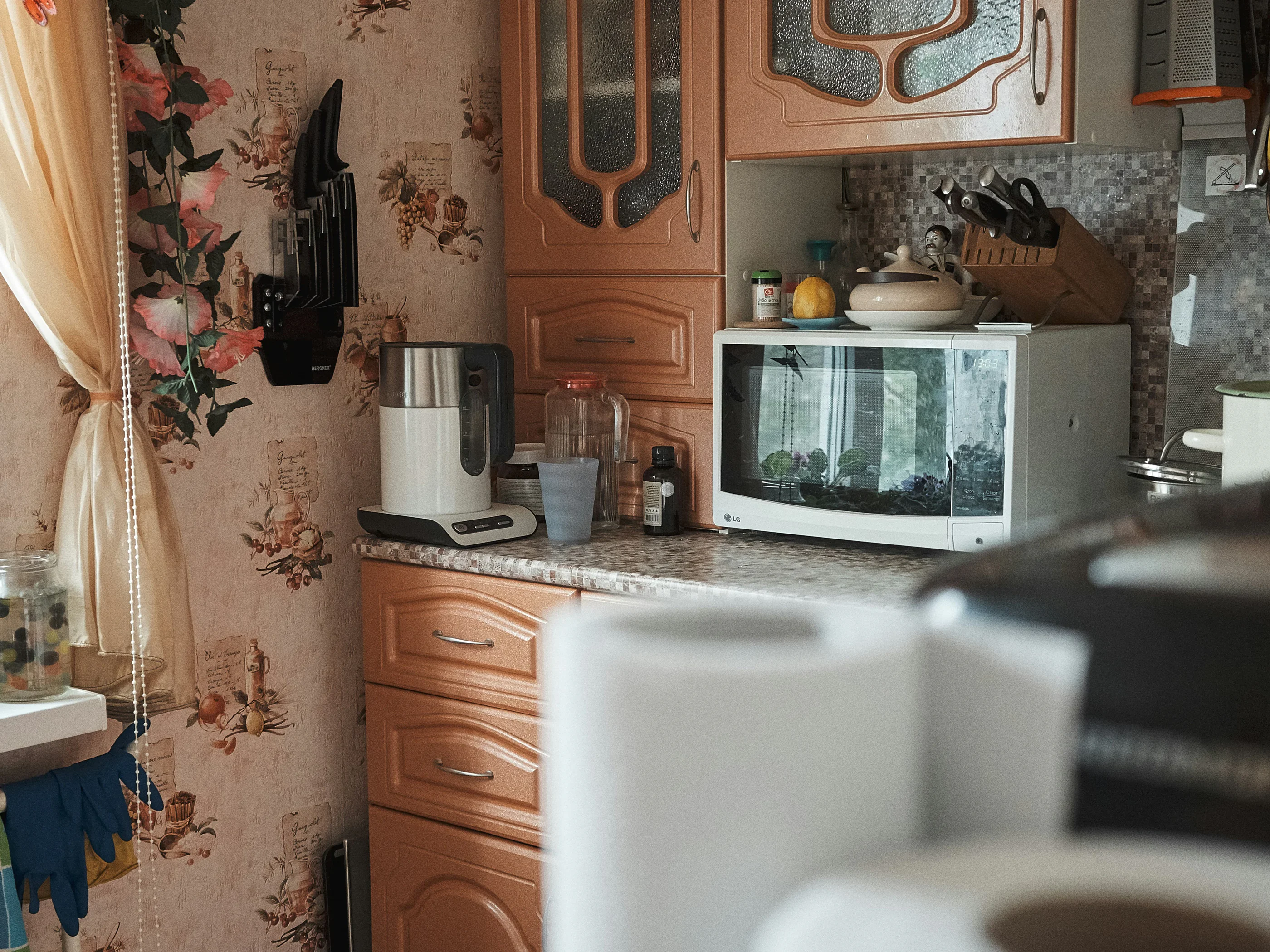
Look at the door while it’s running and you’re not really looking through glass. You’re looking through a sheet of metal, dotted with a few thousand tiny holes, sealed into the window like a screen door built for radiation instead of bugs. That mesh is genuinely clever engineering. It’s also not the interesting part. The interesting part is happening a few inches past it, inside your mug of coffee or your bowl of leftover rice, where nothing is touching the container and it’s getting hot anyway.
The short version
A microwave oven fires 2.45 GHz radio waves into a sealed metal box. Those waves flip the water molecules in your food back and forth billions of times a second, and the friction from all that flipping turns straight into heat. No flame, no hot coil, no direct contact with a heat source required. Just water getting shaken until it warms up.
Why 2.45 GHz, and why it’s not tuned to water
Ask around and you’ll hear that 2.45 gigahertz is tuned to the resonant frequency of water. It isn’t. Liquid water’s actual absorption peak sits much higher, out in the tens of gigahertz, and if ovens really ran on that peak, the outer layer of your food would soak up nearly all the energy and the center would stay cold. The real reason for 2.45 GHz is more practical than that. It falls inside an ISM band, a slice of spectrum regulators set aside for industrial, scientific, and medical equipment so it wouldn’t interfere with radio and phone signals (it’s the same slice Wi-Fi and Bluetooth share now). At that frequency the wavelength works out to about 12 centimeters, short enough to fit inside a countertop box, long enough to actually reach a few centimeters into food instead of cooking only the surface. It’s a compromise between size and depth, not a resonance.
What’s actually happening to the water
The wave itself comes from a magnetron, a device with roots in WWII radar rather than anyone’s kitchen. Inside it, a stream of electrons spirals past a ring of tuned metal cavities, and that motion induces an oscillating electric field at 2.45 GHz, which gets funneled through a waveguide into the cooking chamber. A water molecule has a slightly positive end and a slightly negative end, so as that field flips back and forth, the molecule keeps trying to twist and realign with it. Do that billions of times a second and the molecules never really settle. They jostle their neighbors, hydrogen bonds stretch and snap, and that motion degrades into plain thermal energy. Fats and sugars pick up some energy too, which is why a jelly donut’s filling gets scalding while the dough stays mild, but water is by far the most efficient absorber in the mix.
The “cooks from the inside out” myth
This one’s everywhere, and it’s backwards. Microwaves only penetrate a food’s outer layer, typically somewhere between one and three centimeters depending on density and water content. Past that depth, heat doesn’t arrive by microwave at all, it moves inward the old-fashioned way, by conduction from that outer shell. So a microwave actually heats from the outside in, just starting a bit beneath the surface instead of right at it. The myth sticks around because a moist filling can end up hotter than a dry crust around it, and that feels like proof the wave skipped straight to the center. It didn’t. It just found more water to grab near the surface of the filling than near the surface of the crust.
Why the middle of your bowl stays cold
Inside that metal box, the waves don’t just travel straight to your food and stop. They bounce off the walls and interfere with each other, and that interference locks in a fixed pattern of hot spots and cold spots called standing waves. A turntable exists specifically to drag your food through more of that pattern instead of leaving it parked in one cold node the whole time. Stirring helps a little, but if your oven’s turntable is broken or missing, stirring just relocates the cold food to a different spot in the same static grid. It’s also why food arranged in a ring near the edge of the plate often heats more evenly than the same food piled in a mound at the center: the strongest part of the field usually isn’t sitting right in the middle.
Why a fork throws sparks and the rack doesn’t
Sharp points, thin wires, and crumpled edges concentrate the electric field until it rips electrons off nearby air molecules, and that’s a spark: a tiny bolt of plasma. Flat, smooth, reasonably thick metal has nowhere for that charge to pile up, so it just reflects the wave harmlessly. That’s why the oven’s own walls are metal, why a purpose-built rack is safe, and why a fork or wrinkled foil isn’t. The door mesh runs the same logic in reverse. Its holes are roughly a millimeter across, far smaller than the 12-centimeter cooking wavelength, so the wave can’t get through, but wide open next to the few hundred nanometers of visible light, so you can still watch your food turn. A sealed door keeps leakage well under the limit regulators set.
A microwave and an oven aren’t doing the same job
A conventional oven heats the air around your food, the hot air heats the surface, and the surface passes heat inward by conduction. It’s slow and needs preheating, but it’s the only route to a hot, dry surface that browns and crisps through the Maillard reaction. A microwave skips the air-heating step and acts on water molecules directly through the outer few centimeters, all at once, which is why it’s so much faster. The surface of the food rarely climbs much past the boiling point of water and stays damp the whole time, so nothing ever gets hot and dry enough to brown. These aren’t two versions of the same process. They’re different mechanisms, built for different results.
Where it actually falls short
It can’t brown or crisp. Toast, seared meat, roasted vegetables, none of that happens in a microwave, no matter how long you run it, because the surface chemistry that produces browning needs heat well beyond what a damp, water-driven process can reach.
It’s uneven by design. Standing waves mean fixed hot and cold spots are baked into the physics of the box itself. Turntables and mode stirrers reduce the problem, they don’t erase it, which is why the edges of a reheated plate can be scalding while the center is still cool.
What that means for how you actually use one
If you’re reheating something liquid-heavy, soup, sauce, leftover curry, a microwave is the right tool, since water conducts that energy fast and evenly. If you want something crisp, pizza, fries, fried chicken, skip it or use it only to take the chill off before finishing in an oven or air fryer. When defrosting, use the actual defrost setting rather than full power. It pulses on and off on purpose, giving heat time to conduct inward before the thin edges start cooking while the center is still frozen. Arrange food in a ring near the edge of the plate rather than a mound in the middle, and keep metal flat and smooth if you use it at all, no forks, twist ties, or crumpled foil.
So the next time you’re watching dinner spin behind that dotted window, you’re not looking at anything mysterious, just a caged wave doing to your food’s water molecules what a whisk does to a glass of water, only a few billion times a second, and without ever touching it.